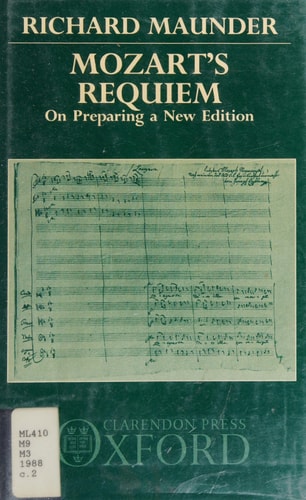
Mozart's Requiem: On Preparing a New Edition
0
0
As an Amazon Associate and affiliate partner, Menrva Books earns from qualifying purchases. Learn more
Author Description
When Mozart died in 1791, he left unfinished the score of his Requiem. At the request of his widow, the work was completed by Mozart's pupil and assistant, Franz Xaver Süssmayr. Unfortunately, Süssmayr was a musician of limited technique and ability--his poor orchestration has frequently been criticized, and considerable controversy has surrounded the question of whether the movements missing from Mozart's autograph were entirely Süssmayr's work, or whether he might have based them on Mozart's sketches or oral instructions.This book is an intensive new study of the background to the Requiem and the music itself. Maunder, who after many years' research has recently completed a new edition of the Requiem that attempts to be more faithful to Mozart's original intentions, presents detailed arguments concerning the authenticity of the doubtful movements, the editorial decisions he faced in preparing the new edition, the settings by other composers that may have influenced Mozart, and the problems of performance practice. He concludes that Süssmayr probably did write the disputed movements, but may have used a now-lost Mozart sketch in composing the Agnus Dei. This fascinating new study of one of classical music's best-loved works will interest a wide range of music students and scholars, and general readers.
Menrva's Summary
THE THESIS
This book investigates the historical authenticity of the movements in Mozart's Requiem and the editorial challenges involved in creating a version that reflects the composer's original intent. Richard Maunder, a musicologist with extensive research experience, analyzes the collaboration between Mozart and his assistant, Franz Xaver Süssmayr. By examining the surviving autograph, contemporary influences, and the limitations of Süssmayr's technique, Maunder constructs a framework for evaluating which portions of the work are definitively Mozart's and which represent later additions.
THE SCOPE MAP
What You Will Find
- Historical analysis of the Requiem's composition and completion process
- Technical evaluation of Süssmayr's orchestration and musical contributions
- Comparative study of contemporary settings that influenced Mozart's work
- Editorial methodology for reconstructing unfinished musical scores
Scope Limits
- Does not provide a comprehensive biography of Mozart beyond the context of the Requiem
- Does not serve as a general performance guide for all classical choral works
THE AUTHORITY PERSPECTIVE
Scholars and music students frequently cite this work as a critical resource for understanding the editorial complexities of the Requiem. Experts highlight the text for its rigorous technical analysis and its significant contribution to the ongoing debate regarding the authenticity of the disputed movements.
Page Count:
240
Publication Date:
1988-08-18
Publisher:
Oxford University Press
ISBN-10:
0193164132
ISBN-13:
9780193164130
Biography
Musicology
Music History
Music theory
Music editing
Community Tags
Similar Books