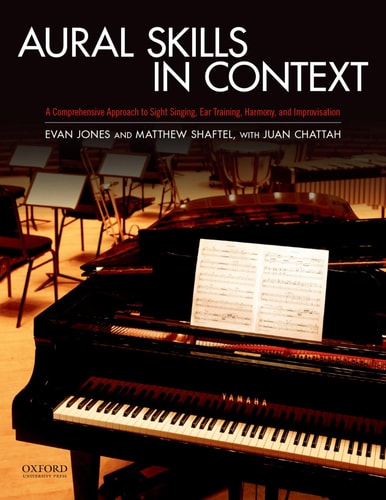
Aural Skills in Context: A Comprehensive Approach to Sight Singing, Ear Training, Keyboard Harmony, and Improvisation
0
0
As an Amazon Associate and affiliate partner, Menrva Books earns from qualifying purchases. Learn more
Author Description
Aural Skills in Context takes a comprehensive approach to sight singing, ear training, and rhythm practice. By featuring real examples from classical music to folk and jazz, and offering melodies with their related harmonies, the text parallels the full Music Theory curriculum and reinforces the relevance of aural skills to students' other classes, as well as their performance and listening interests. In addition to a wide variety of partial and complete excerpts, Aural Skills in Context also provides a wealth of activities that range far beyond simply singing the melodies or writing them down from dictation, giving instructors and students the opportunity to engage in improvisation; performance in multiple voices; switching between melody and accompanying lines; creating new melodies above a given bass line; or even an additional "obbligato" voice above the given melody or between the outer voices.* Rhythmic, harmonic, and melodic drills accompany musical examples and solidify students' understanding of the position of every pitch within the tonal context* "Expanding Repertoires" sections include listening and dictation-type exercises that allow students to engage in listening beyond the traditional examples* "Contextual Listening" assignments are accompanied with streaming audio at various tempos and an online mixer for balancing musical parts on the companion website, www.oup.com/us/jonesshaftel* Designed so that it may be used with Finale Smartmusic, an inexpensive software program that enables students to receive immediate feedback on their sight singing, while keeping a record of their progress.
Menrva's Summary
THE THESIS
This text investigates the integration of aural skills—specifically sight singing, ear training, and keyboard harmony—into a unified pedagogical framework that mirrors the broader music theory curriculum. Authors Evan Jones, Juan Chattah, and Matthew R. Shaftel leverage their academic expertise to move beyond isolated drills, arguing that students learn most effectively when aural training is contextualized within actual musical repertoire. By utilizing diverse examples ranging from classical compositions to folk and jazz, the authors provide a structured method for students to synthesize listening, performance, and theoretical analysis.
THE SCOPE MAP
What You Will Find
- Comprehensive exercises covering sight singing, rhythm practice, and keyboard harmony.
- A diverse collection of musical excerpts spanning classical, folk, and jazz traditions.
- Interactive methodologies including improvisation, multi-voice performance, and melodic creation.
- Integration with digital tools such as Finale Smartmusic and online audio mixers for contextual listening assignments.
THE AUTHORITY PERSPECTIVE
Educators frequently cite this text as a robust, multi-faceted resource that successfully bridges the gap between abstract theory and practical musicianship. The consensus among music faculty is that its emphasis on contextualized learning provides a more holistic and engaging experience for students compared to traditional, drill-heavy curricula.
Page Count:
864
Publication Date:
2013-10-12
Publisher:
Oxford University Press
ISBN-10:
0199943826
ISBN-13:
9780199943821
Music
Education
Ear Training
Harmony
Sight Singing
Music theory
Reference
textbook
Community Tags
Similar Books