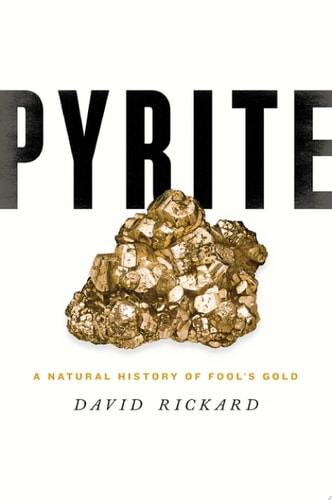
Pyrite: A Natural History of Fool's Gold
0
0
As an Amazon Associate and affiliate partner, Menrva Books earns from qualifying purchases. Learn more
Author Description
Most people have heard of pyrite, the brassy yellow mineral sometimes known as fool's gold. Pyrite behaves like stone and shines like metal, and its dual nature makes it a source of both metals and sulfur. Despite being the most common sulfide mineral on the earth's surface, pyrite's bright crystals have attracted the attention of many different cultures, and its nearly identical visual appearance to gold has led to tales of fraud, trickery, and claims of alchemy. Pyrite occupies a unique place in human history: it became an integral part of mining culture in America during the 19th century, and it has a presence in ancient Sumerian texts, Greek philosophy, and medieval poetry, becoming a symbol for anything overvalued. In Pyrite, geochemist and author David Rickard blends basic science and historical narrative to describe the many unique ways pyrite is integral to our world. He explains the basic science of oxidation, showing us why the mineral looks like gold, and inspects death zones of present oceans where pyrite-related hydrogen sulfide destroys oxygen in the waters. Rickard analyzes pyrite's role in manufacturing sulfuric acid and discusses the significant appearance of the mineral in literature, history, and the development of societies. The mineral's influence extends from human evolution and culture, through science and industry, to our understanding of ancient, modern, and future earth environments. Energetic and accessible, Pyrite is the first book to show readers the history and science of a mineral that helped make the modern world.
Menrva's Summary
THE THESIS
This book investigates the multifaceted role of pyrite, the most common sulfide mineral on Earth, by examining its chemical properties and its long-standing influence on human history and industrial development. Geochemist David Rickard utilizes his expertise to bridge the gap between geological science and cultural history. He presents a framework that connects the mineral's physical characteristics, such as its oxidation processes and sulfur content, to its broader impact on ancient civilizations, mining culture, and modern environmental systems. The text synthesizes scientific data with historical anecdotes to illustrate how a single mineral has shaped both natural environments and human societies.
THE SCOPE MAP
What You Will Find
- Chemical analysis of pyrite oxidation and its role in sulfuric acid production
- Historical overview of pyrite in Sumerian texts, Greek philosophy, and medieval literature
- Examination of pyrite's impact on ocean oxygen levels and modern environmental death zones
- Case studies on the role of pyrite in 19th-century American mining culture
Scope Limits
- The text does not provide a comprehensive field guide for mineral identification or amateur collecting
- It does not focus on the economic investment potential of gold mining or precious metal markets
THE AUTHORITY PERSPECTIVE
Experts and readers alike note that the book successfully balances technical geochemical explanations with accessible historical narratives. It is frequently cited as a comprehensive resource for those interested in the intersection of mineralogy and human civilization.
Page Count:
297
Publication Date:
2015-01-01
Publisher:
Oxford University Press
ISBN-10:
0190203692
ISBN-13:
9780190203696
Science
Natural History
Mineralogy
Chemistry
Science History
Pyrites
Earth Sciences
Geology
Community Tags
Similar Books