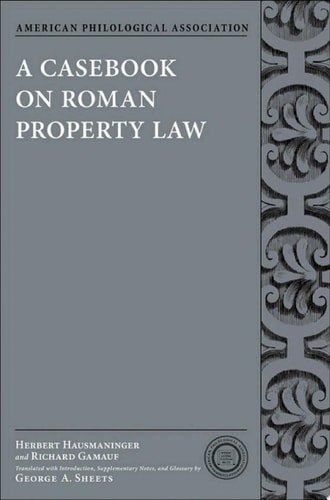
A Casebook on Roman Property Law
0
0
As an Amazon Associate and affiliate partner, Menrva Books earns from qualifying purchases. Learn more
Author Description
This book provides a thorough introduction to Roman property law by means of "cases," consisting of brief excerpts from Roman juristic sources in the original Latin with accompanying English translations. The cases are selected and grouped so as to provide an overview of each topic and an orderly exposition of its parts. To each case is attached a set of questions that invite the reader to, e.g., clarify ambiguities in the jurist's argument, reconcile one holding with another, supply missing but necessary facts to account for the holding, and/or engage in other analytical activities. The casebook also illustrates the survival and adaptation of elements of Roman property law in the modern European civil codes, especially the three most influential of those codes: the General Civil Code of Austria (Allgemeines Bürgerliches Gesetzbuch), the German Civil Code (Bürgerliches Gesetzbuch), and the Civil Code of Switzerland (Zivilgesetzbuch). All code excerpts are accompanied by English translations. By comparing and contrasting how the codes have adopted, adapted, or rejected an underlying Roman rule or concept, it is possible for the reader to observe the dynamic character and continuing life of the Roman legal tradition. To facilitate comparison with corresponding rules and concepts in the English common law tradition, additional texts and questions prepared by the translator will be mounted on an accompanying website, www.oup.com/us/romanpropertylaw.
Menrva's Summary
THE THESIS
This text investigates the foundational principles of Roman property law through the analysis of primary juristic sources and their subsequent integration into modern European civil codes. Herbert Hausmaninger and Richard Gamauf utilize a pedagogical casebook approach, presenting original Latin excerpts alongside English translations to facilitate rigorous legal inquiry. The authors argue that by examining the evolution of these rules, students can better understand the logical structure and enduring influence of Roman jurisprudence on contemporary legal systems.
THE SCOPE MAP
What You Will Find
- Primary source excerpts from Roman juristic texts with English translations
- Comparative analysis of the Austrian, German, and Swiss civil codes
- Analytical questions designed to test legal reasoning and reconciliation of conflicting holdings
- Supplementary digital resources for common law comparisons
Scope Limits
- Does not provide an exhaustive history of Roman political institutions
- Does not cover criminal law or procedural law outside the context of property disputes
THE AUTHORITY PERSPECTIVE
Legal scholars and students frequently identify this work as a primary resource for understanding the technical application of Roman property concepts. Experts highlight the text's utility in bridging the gap between ancient legal theory and modern civil code practice.
Page Count:
371
Publication Date:
2012-01-01
Publisher:
Oxford University Press
ISBN-10:
0190207981
ISBN-13:
9780190207984
History
Ancient History
LAW Property
Professional Career & Trade
Property Law
Law
Academic
Legal History
Roman law
Community Tags
Other Editions(4)

Similar Books











Reader Comments
Share Your Thoughts
No comments yet. Be the first to share your thoughts!