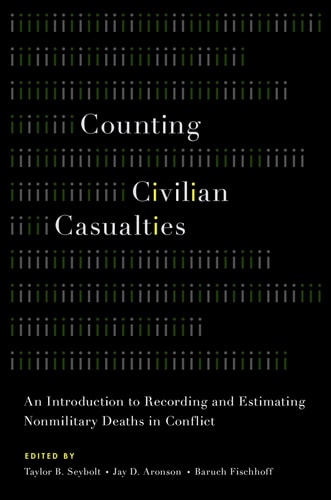
Counting Civilian Casualties: An Introduction to Recording and Estimating Nonmilitary Deaths in Conflict
0
0
As an Amazon Associate and affiliate partner, Menrva Books earns from qualifying purchases. Learn more
Author Description
A popular myth emerged in the late 1990s: in 1900, wars killed one civilian for every eight soldiers, while contemporary wars were killing eight civilians for every one soldier. The neat reversal of numbers was memorable, and academic publications and UN documents regularly cited it. The more it was cited, the more trusted it became. In fact, however, subsequent research found no empirical evidence for the idea that the ratio of civilians to soldiers killed in war has changed dramatically. But while the ratios may not have changed, the political significance of civilian casualties has risen tremendously.Over the past century, civilians in war have gone from having no particular rights to having legal protections and rights that begin to rival those accorded to states. The concern for civilians in conflict has become so strong that governments occasionally undertake humanitarian interventions, at great risk and substantial cost, to protect strangers in distant lands. I n the early 1990s, the UN Security Council authorized military interventions to help feed and protect civilians in the Kurdish area of Iraq, Somalia, and Bosnia. And in May 2011, Barack Obama 's National Security Advisor explained the United States' decision to support NATO's military intervention in these terms "When the president made this decision, there was an immediate threat to 700,000 Libyan civilians in the town of Benghazi. We've had a success here in terms of being able to protect those civilians."Counting Civilian Casualties aims to promote open scientific dialogue by high lighting the strengths and weaknesses of the most commonly used casualty recording and estimation techniques in an understandable format. Its thirteen chapters, each authoritative but accessible to nonspecialists, explore a variety of approaches, from direct recording to statistical estimation and sampling, to collecting data on civilian deaths caused by conflict. The contributors also discuss their respective advantages a
Menrva's Summary
THE THESIS
This book investigates the methodological challenges and ethical imperatives involved in accurately recording and estimating civilian deaths during armed conflict. The authors, a multidisciplinary team of experts including Baruch Fischhoff, Jay D. Aronson, and Taylor B. Seybolt, argue that while the political significance of civilian casualties has grown, the data collection methods remain inconsistent and prone to error. By evaluating various techniques, the text provides a framework for improving the transparency and scientific rigor of casualty reporting in volatile environments.
THE SCOPE MAP
What You Will Find
- Comparative analysis of direct recording versus statistical estimation and sampling techniques.
- Evaluation of the strengths and weaknesses of current data collection methodologies in conflict zones.
- Historical context regarding the shifting political and legal status of civilians in modern warfare.
- Practical guidance for researchers and policymakers on navigating the complexities of casualty data.
THE AUTHORITY PERSPECTIVE
Experts identify this work as a foundational text for understanding the intersection of humanitarian policy and statistical analysis. Readers frequently note the clarity of the prose, which makes complex methodological issues accessible to both academics and practitioners in the field of peacebuilding.
Page Count:
336
Publication Date:
2013-06-11
Publisher:
Oxford University Press
ISBN-10:
0199977313
ISBN-13:
9780199977314
War Victims
Human rights
International relations
Peace studies
War
Statistics
Community Tags
Similar Books


Reader Comments
Share Your Thoughts
No comments yet. Be the first to share your thoughts!