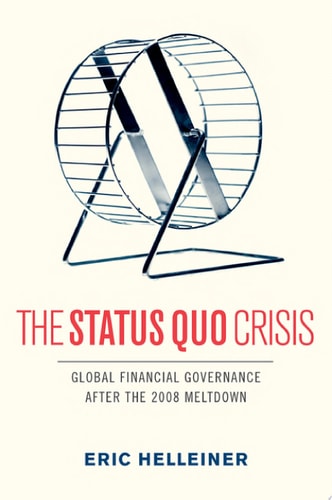
The Status Quo Crisis: Global Financial Governance After the 2008 Meltdown
0
0
As an Amazon Associate and affiliate partner, Menrva Books earns from qualifying purchases. Learn more
Author Description
The 2008 financial crisis was the worst since the Great Depression and many voices argued that it would transform global financial governance. Analysts anticipated a "Bretton Woods moment", referring to the 1944 conference that established the postwar international financial order. Widespread expectations of change were then reinforced by the creation of the G20 leaders' forum, extensive debates about the dollar's global role, the launching of international financial regulatory reforms, and the establishment of the Financial Stability Board. But half a decade later, how much has really changed? In The Status Quo Crisis, Helleiner surveys the landscape and argues that continuity has marked global financial governance more than dramatic transformation. The G20 leaders forum contributed much less to the management of the crisis than advertised. The US dollar remains unchallenged as the world's dominant international currency. The market-friendly nature of pre-crisis international financial regulation has been not overturned in a significant manner. And the Financial Stability Board has strengthened the governance of international financial standards in only very modest ways. What we are left with are some small-bore incremental changes that, collectively, have not fundamentally restructured the governance of the global financial system. Helleiner argues that this strangely conservative result was generated partly by the structural power and active policy choices of the country at the center of the crisis: the United States. Status quo outcomes also reflected the unexpected weakness of Europe and conservatism of policymakers in large emerging market countries. Only if this distinct configuration of power and politics among and within influential states shifted in the coming years might the 2008 crisis leave a more transformative legacy over the longer term. Cutting against much of the received wisdom on offer today, The Status Quo Crisis will be essential reading for th
Menrva's Summary
THE THESIS
Did the 2008 financial crisis fundamentally transform global financial governance, or did it reinforce existing structures? Eric Helleiner, a professor of political science, examines the aftermath of the 2008 meltdown to determine why the anticipated "Bretton Woods moment" of radical reform failed to materialize. By analyzing the policy decisions of major global powers, he argues that the international financial order remained largely unchanged due to the structural dominance of the United States and the conservative tendencies of emerging market policymakers.
THE SCOPE MAP
What You Will Find
- Analysis of the G20 leaders' forum and its limited impact on crisis management.
- Evaluation of the Financial Stability Board and its modest regulatory contributions.
- Examination of the continued dominance of the US dollar in international markets.
- Assessment of the political and structural factors that prevented significant post-crisis reform.
THE AUTHORITY PERSPECTIVE
Experts recognize this work as a critical counter-narrative to the belief that the 2008 crisis triggered a paradigm shift in global finance. Readers frequently note the academic rigor and the clear, evidence-based approach Helleiner uses to challenge prevailing assumptions about international regulatory reform.
Page Count:
256
Publication Date:
2014-01-01
Publisher:
Oxford University Press
ISBN-10:
0199973652
ISBN-13:
9780199973651
Economics
History
International relations
Finance
Community Tags
Similar Books