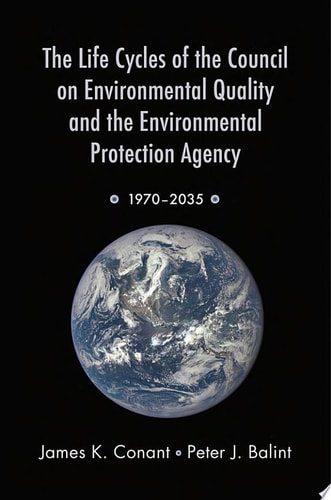
The Life Cycles of the Council on Environmental Quality and the Environmental Protection Agency: 1970-2035
0
0
As an Amazon Associate and affiliate partner, Menrva Books earns from qualifying purchases. Learn more
Author Description
In 1970, due to increasing public concern about the environment, a dramatic series of bipartisan actions were taken to expand the national government's efforts to control pollutants. In that year, the Congress and President Nixon established two key federal agencies to address the nation's growing environmental problems: the Council on Environmental Quality (CEQ) and the Environmental Protection Agency (EPA). But despite this initial recognition of the pressing problems presented by environmental degradation, support for related policymaking and administration waxed and waned over the next thirty-five years, as other domestic and foreign policy problems rose to the top of the public and legislative agendas. What does the future hold for environmental policy in the United States, given the highly polarized politics surrounding the issue today? In this book, James K. Conant and Peter J. Balint examine what happened to the CEQ and EPA between 1970 and 2010 by using changes in leadership and budgetary resources as key indicators of the agencies' vitality and capacity for implementing pollution control laws. They also examine correlations between the agencies' fortunes and various social, political, and economic variables. The authors conclude with several scenarios about what the future holds for these important environmental agencies.
Menrva's Summary
THE THESIS
This book investigates the factors influencing the institutional vitality and administrative capacity of the Council on Environmental Quality (CEQ) and the Environmental Protection Agency (EPA) from their inception in 1970 through the early 21st century. James K. Conant and Peter J. Balint utilize a longitudinal analysis of budgetary allocations and leadership stability to measure how these agencies have navigated shifting political climates. By correlating agency performance with broader social and economic variables, the authors provide a framework for understanding the cyclical nature of federal environmental governance. The work concludes by projecting potential future trajectories for these agencies within the context of contemporary political polarization.
THE SCOPE MAP
What You Will Find
- A detailed historical analysis of the CEQ and EPA from 1970 to 2010.
- Quantitative assessment of budgetary resources and leadership turnover as indicators of agency health.
- Comparative analysis of environmental policy support across different presidential administrations.
- Predictive scenarios regarding the future of federal environmental regulation.
Scope Limits
- The analysis focuses primarily on federal-level administrative and legislative dynamics rather than state-level implementation.
- The study does not provide an exhaustive technical review of specific pollution control technologies.
THE AUTHORITY PERSPECTIVE
Experts identify this work as a rigorous administrative history that provides a clear methodology for assessing federal agency performance over time. Readers frequently note the academic density of the prose, which makes it a useful resource for students and practitioners of public policy.
Page Count:
218
Publication Date:
2016-01-01
Publisher:
Oxford University Press
ISBN-10:
0190203730
ISBN-13:
9780190203733
History
Public Administration
Public Policy
United States
Government
Community Tags
Similar Books