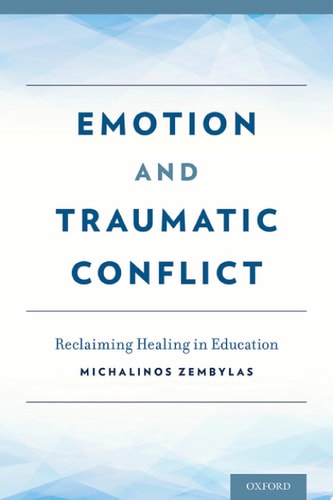
Emotion and Traumatic Conflict: Reclaiming Healing in Education
0
0
As an Amazon Associate and affiliate partner, Menrva Books earns from qualifying purchases. Learn more
Author Description
Do the emotional responses of students and to traumatic conflict constitute insurmountable obstacles in peace education efforts? How do hegemonic narratives shape the emotions of ethnic identity and collective memory, and what can be done pedagogically to transform the powerful influence of such narratives and emotions? Can peace education efforts that foreground emotion in critical ways become a productive pedagogical intervention in conflicted societies? Emotion and Traumatic Conflict takes us through an ethnographic journey into a specific site of conflict to show how emotions are entangled with educational efforts towards peacebuilding, healing, and reconciliation. While sociologists, anthropologists, historians, and political scientists have long analyzed the emotional dynamics of conflict and peace, rarely have educators looked into the emotional complexities of traumatic conflict, the impact of emotion in everyday school interactions and pedagogical practices, and the consequences of the role of emotion in what has become known as "critical peace education." This book not only offers an analysis of the emotional consequences of traumatic conflict in schools, it also develops an innovative, compelling, and cross-disciplinary perspective on the entanglement of emotion, power, politics, trauma, healing, and critical education. The book provides a detailed ethnographic analysis of the ideological appropriation of emotions of conflict in schools, yet it pushes boundaries further through a theorization of the consequences of this appropriation and the pedagogical interventions required to challenge, undermine, or subvert this process. Zembylas argues that these pedagogical interventions, rooted in both psychoanalytic and socio-political perspectives of trauma and emotion, ought to engage emotions as critical and transformative forces in peace education. Grounded in recent literature on affect and emotion that spans the social sciences, Zembylas's analysis of the em
Menrva's Summary
THE THESIS
This book investigates whether the emotional responses of students to traumatic conflict serve as insurmountable barriers to peace education or if they can be leveraged as transformative pedagogical tools. Michalinos Zembylas, a scholar specializing in the intersection of emotion, politics, and education, utilizes ethnographic research to examine how hegemonic narratives shape ethnic identity and collective memory within schools. By synthesizing psychoanalytic theory with socio-political frameworks, the author argues that educators must actively engage with the emotional consequences of trauma to subvert the ideological appropriation of conflict in classroom settings.
THE SCOPE MAP
What You Will Find
- Ethnographic analysis of emotional dynamics in schools located in regions of active or historical conflict.
- Theoretical framework integrating psychoanalytic perspectives with critical peace education methodologies.
- Examination of how hegemonic narratives influence student emotions regarding ethnic identity and collective memory.
- Pedagogical strategies for subverting the political appropriation of trauma to foster reconciliation and healing.
THE AUTHORITY PERSPECTIVE
Experts in the field of peace education identify this work as a significant contribution to the study of affect and pedagogy. Readers frequently note the academic density of the prose, which serves as a foundational text for those researching the intersection of trauma, power, and classroom practice.
Page Count:
274
Publication Date:
2015-01-01
Publisher:
Oxford University Press
ISBN-10:
0199982783
ISBN-13:
9780199982783
Psychology
Sociology
Education
Peace studies
Conflict Resolution
Pedagogy
Community Tags
Similar Books