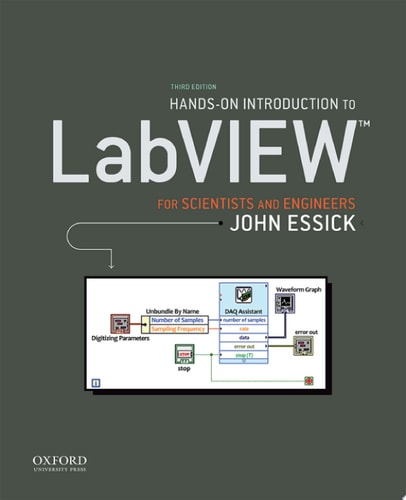
Hands-On Introduction to LabVIEW for Scientists and Engineers
0
0
As an Amazon Associate and affiliate partner, Menrva Books earns from qualifying purchases. Learn more
Author Description
Hands-On Introduction to LabVIEW for Scientists and Engineers, Third Edition, explores practical programming solutions for carrying out interesting and relevant projects. Readers--who are assumed to have no prior computer programming or LabVIEW background--will begin writing meaningful programs in the first few pages.Improvements to the Third Edition: This new edition includes the following improvements:* All chapters are fully updated to the latest version of LabVIEW. DAQ hardware now commonly used in instructional laboratories and self-learning is highlighted.* For easy reference, seven chapters begin with a "Basics" section that explains the fundamental operation of the LabVIEW function covered in that chapter [Chapters 2, 3, 4, 7, 8, 9, 12].* A new first chapter offers focused introduction to the LabVIEW programming environment. Readers construct a simple program to detect whether a given integer is even or odd [Chapter 1].* Coverage of LabVIEW's text-based functions is given for both the MathScript Node and Formula Node [Chapter 4 and Appendix A].* Shift register usage is illustrated through a signal-averaging program (replacing the numerical integration and differentiation programs used in previous editions) [Chapter 7].* State machine program architecture is now taught in the case structure chapter (replacing the numerical integration program used in previous editions). Readers construct a state-machine guessing game and a digital oscilloscope with runtime control [Chapter 8].* A nonlinear curve fitting example is included in the text [Chapter 10].* The fast Fourier transform chapter opens with an Express VI-based "Quick Example" section, which gives a concise introduction to the digital spectral analysis topics of leakage and windowing. High-level mathematical coverage of these topics is moved to an appendix [Chapter 11 and Appendix B].* The proportional-integral-derivative temperature control project is now given in an appendix [Appendix C].* About 20 new e
Menrva's Summary
THE THESIS
This text investigates the core question of how scientists and engineers with no prior programming experience can effectively utilize LabVIEW to develop practical, data-driven solutions. Prof. John Essick, a professor of physics, leverages his extensive experience in instructional laboratory design to provide a structured, step-by-step framework for mastering graphical programming. The book argues that by focusing on immediate, hands-on project construction, learners can bypass traditional theoretical hurdles and achieve functional proficiency in instrument control and data analysis.
THE SCOPE MAP
What You Will Find
- Comprehensive tutorials on LabVIEW programming environments and architecture.
- Practical implementation of state machines, shift registers, and text-based nodes.
- Integration techniques for modern DAQ hardware used in instructional and research settings.
Scope Limits
- The text does not provide an exhaustive reference for every advanced LabVIEW library or niche industrial application.
- High-level mathematical derivations are relegated to appendices to maintain focus on programming mechanics.
THE AUTHORITY PERSPECTIVE
Experts and educators frequently highlight this text as a foundational resource for students and professionals entering the field of laboratory automation. Readers often note the clarity of the instructional design, which balances technical density with accessible, project-based learning objectives.
Page Count:
668
Publication Date:
2015-05-27
Publisher:
Oxford University Press
ISBN-10:
019021189X
ISBN-13:
9780190211899
Programming
Science
LabVIEW
Engineering
Computer Science
Scientific Computing
Community Tags
Similar Books