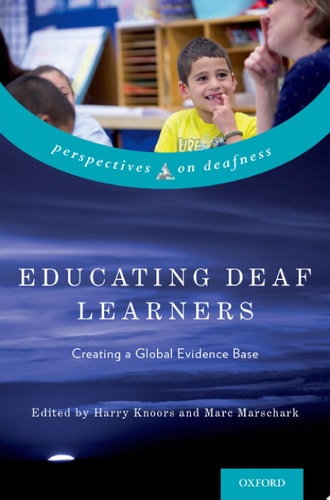
Educating Deaf Learners: Creating a Global Evidence Base
0
0
As an Amazon Associate and affiliate partner, Menrva Books earns from qualifying purchases. Learn more
Author Description
Education in general, and education for deaf learners in particular, has gone through significant changes over the past three decades. And change certainly will be the buzzword in the foreseeable future. The rapid growth of information and communication technology as well as progress in educational, psychological, and allied research fields have many scholars questioning aspects of traditional school concepts. For example, should the classroom be "flipped" so that students receive instruction online at home and do "homework" in school? At the same time, inclusive education has changed the traditional landscape of special education and thus of deaf education in many if not all countries, and yet deaf children continued to lag significantly behind hearing peers in academic achievement. As a consequence of technological innovations (e.g., digital hearing aids and early bilateral cochlear implants), the needs of many deaf learners have changed considerably. Parents and professionals, however, are just now coming to recognize that there are cognitive, experiential, and social-emotional differences between deaf and hearing students likely to affect academic outcomes. Understanding such differences and determining ways in which to accommodate them through global cooperation must become a top priority in educating deaf learners.Through the participation of an international, interdisciplinary set of scholars, Educating Deaf Learners takes a broader view of learning and academic achievement than any previous work, considering the whole child. In adopting this broad perspective, the authors capture the complexities and commonalities in the social, emotional, cognitive, and linguistic mosaic of which the deaf child is a part. It is only through such a holistic consideration that we can understand their academic potential.
Menrva's Summary
THE THESIS
This book investigates how global educational practices can be adapted to address the persistent academic achievement gap between deaf and hearing students through a holistic, evidence-based framework. Authors Harry Knoors and Marc Marschark, both established scholars in the field of deaf education, synthesize interdisciplinary research to argue that traditional school models are insufficient for the changing needs of deaf learners. They propose that by integrating cognitive, social-emotional, and linguistic data, educators and policymakers can better support the academic potential of deaf children in an era of rapid technological and inclusive change.
THE SCOPE MAP
What You Will Find
- Analysis of the impact of digital hearing aids and cochlear implants on student needs
- Evaluation of modern pedagogical shifts like the flipped classroom model
- Synthesis of international, interdisciplinary research on cognitive and social-emotional development
- Frameworks for global cooperation in special education policy
Scope Limits
- Does not provide specific lesson plans or classroom curriculum materials
- Does not focus on the history of sign language linguistics beyond its role in academic outcomes
THE AUTHORITY PERSPECTIVE
Experts in the field of special education recognize this work as a comprehensive synthesis of contemporary challenges in deaf education. Readers frequently note the academic density of the prose, making it a primary resource for researchers, graduate students, and policy developers.
Page Count:
688
Publication Date:
2015-07-08
Publisher:
Oxford University Press
ISBN-10:
0190215194
ISBN-13:
9780190215194
Psychology
Deaf education
Pedagogy
Deaf Studies
Academic Research
Education
Special Education
Community Tags
Similar Books