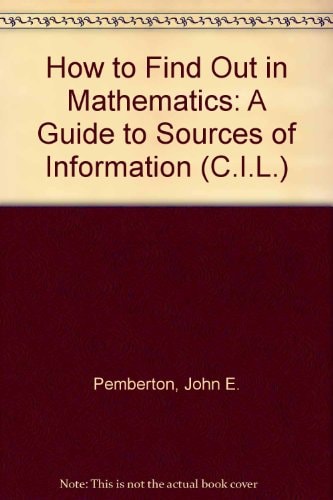
How to Find Out in Mathematics: A Guide to Sources of Information, (C.I.L.)
0
0
As an Amazon Associate and affiliate partner, Menrva Books earns from qualifying purchases. Learn more
Author Description
How to Find Out in A Guide to Sources of Information, Second Revised Edition presents updated topics about probability and statistics, dictionaries and encyclopedias, computing, and mathematical education. The book discusses the modifications of the content of professional actuarial examinations; the assimilation of modern mathematics into the school curriculum; and the establishment of government departments to administer financial support for mathematical research. The text also describes the efforts to improve communication between mathematicians (i.e. the inception of the Mathematical Offprint Service and the publication of Contents of Contemporary Mathematical Journals by the American Mathematical Society). People who are studying, teaching, or applying mathematics will find the book helpful.
Menrva's Summary
THE THESIS
This text serves as a comprehensive guide for navigating the vast landscape of mathematical literature, research resources, and professional information systems. John E. Pemberton, an expert in information science, provides a structured methodology for locating specialized data, historical records, and contemporary journals. The book argues that effective research in mathematics requires a systematic understanding of both traditional reference materials and emerging digital or organizational communication channels.
THE SCOPE MAP
What You Will Find
- Bibliographic resources for probability, statistics, and computing
- Directories of mathematical education and curriculum development
- Analysis of professional actuarial examination structures
- Overviews of government-funded research administration
Scope Limits
- Does not provide instruction on solving specific mathematical proofs or equations
- Focuses primarily on mid-20th-century information systems and may not reflect current digital database standards
THE AUTHORITY PERSPECTIVE
Experts recognize this work as a foundational reference for librarians and researchers seeking to organize mathematical information. Readers frequently note the academic density of the prose, which serves as a detailed manual for navigating the institutional infrastructure of the field.
Page Count:
208
Publication Date:
1969-01-01
Publisher:
PERGAMON
ISBN-10:
0080068243
ISBN-13:
9780080068244
Academic Research
Education
Reference
Information Science
Mathematics
Community Tags
Similar Books