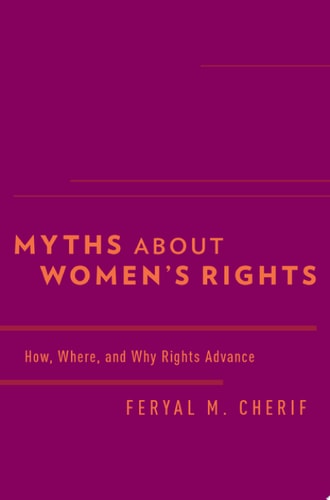
Myths about Women's Rights: How, Where, and Why Rights Advance
0
0
As an Amazon Associate and affiliate partner, Menrva Books earns from qualifying purchases. Learn more
Author Description
Two conventional wisdoms dominate debates about why women's rights advance in some places but not others. While culture and religion are understood to be the primary barriers to gender equality, efforts by international institutions and women's groups to change social norms are often seen as the most effective way to reduce discrimination.This book introduces a third, often overlooked explanation - the core rights framework - to account for how, where, and why women's rights advance. It argues that female labor force participation and education serve as building blocks, or core rights, for the advancement of other women's rights. Cultivating core rights is believed to spur group consciousness, ease collective action problems, and render women in a politically relevant group, thereby increasing the prospects that women's rights are represented in the polity. In examining the advancement of women's rights across four major areas - political, nationality, reproductive, and property rights - this book shows that the conventional wisdom about the role of international norms and culture is usually overstated and often incomplete. It also presents systematic evidence evaluating the effectiveness of different prescriptions for improving women's lives across a broad range of rights.
Menrva's Summary
THE THESIS
This book investigates the core rights framework as a primary driver for the advancement of women's rights, challenging the conventional emphasis on culture and international norms. Feryal M. Cherif, a scholar in political science, utilizes systematic evidence to argue that female labor force participation and education act as foundational building blocks for broader gender equality. By analyzing how these core rights foster group consciousness and political relevance, the author provides a new framework for understanding the mechanisms of social and legal progress.
THE SCOPE MAP
What You Will Find
- Analysis of four major rights areas: political, nationality, reproductive, and property rights.
- The core rights framework theory linking labor participation and education to systemic change.
- Systematic evidence evaluating the effectiveness of various international and local prescriptions for gender equality.
Scope Limits
- The study focuses primarily on structural and political mechanisms rather than an exhaustive analysis of specific religious or cultural doctrines.
- The research does not provide a comprehensive history of every global women's rights movement.
THE AUTHORITY PERSPECTIVE
Experts in political science and gender studies highlight this work as a significant contribution to the debate on how rights evolve in diverse political climates. Readers frequently note the academic rigor of the prose and the author's ability to synthesize complex data into a coherent, evidence-based argument.
Page Count:
296
Publication Date:
2015-06-01
Publisher:
Oxford University Press
ISBN-10:
0190211172
ISBN-13:
9780190211172
Public Policy
Women
Human rights
Womens rights
Womens Studies
Sociology
International relations
Community Tags
Similar Books