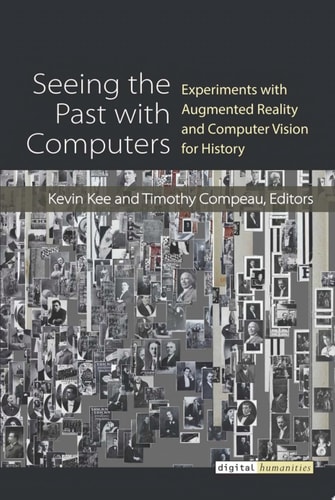
Seeing the Past with Computers: Experiments with Augmented Reality and Computer Vision for History
0
0
As an Amazon Associate and affiliate partner, Menrva Books earns from qualifying purchases. Learn more
Author Description
Recent developments in computer technology are providing historians with new ways to see—and seek to hear, touch, or smell—traces of the past. Place-based augmented reality applications are an increasingly common feature at heritage sites and museums, allowing historians to create immersive, multifaceted learning experiences. Now that computer vision can be directed at the past, research involving thousands of images can recreate lost or destroyed objects or environments, and discern patterns in vast datasets that could not be perceived by the naked eye.Seeing the Past with Computers is a collection of twelve thought-pieces on the current and potential uses of augmented reality and computer vision in historical research, teaching, and presentation. The experts gathered here reflect upon their experiences working with new technologies, share their ideas for best practices, and assess the implications of—and imagine future possibilities for—new methods of historical study. Among the experimental topics they explore are the use of augmented reality that empowers students to challenge the presentation of historical material in their textbooks; the application of seeing computers to unlock unusual cultural knowledge, such as the secrets of vaudevillian stage magic; hacking facial recognition technology to reveal victims of racism in a century-old Australian archive; and rebuilding the soundscape of an Iron Age village with aural augmented reality.This volume is a valuable resource for scholars and students of history and the digital humanities more broadly. It will inspire them to apply innovative methods to open new paths for conducting and sharing their own research.
Menrva's Summary
THE THESIS
This collection explores the transformative potential of augmented reality and computer vision in reshaping historical research, teaching, and public presentation. The book features twelve expert contributions that reflect on their practical experiences with these emerging technologies, offering insights into best practices and envisioning future methodologies for historical study. It examines innovative applications such as empowering students to critically engage with historical narratives through AR, utilizing computer vision to uncover hidden cultural knowledge like vaudevillian stage magic, and employing facial recognition to identify victims of racism in historical archives. The volume also considers the reconstruction of historical sensory experiences, such as recreating the soundscape of an Iron Age village.
THE SCOPE MAP
- Exploration of place-based augmented reality applications at heritage sites and museums.
- Use of computer vision for recreating lost objects/environments and discerning patterns in large datasets.
- Case studies on AR empowering students to challenge textbook historical presentations.
- Application of computer vision to unlock unusual cultural knowledge, exemplified by vaudevillian stage magic.
- Hacking facial recognition technology to reveal victims of racism in historical archives.
- Rebuilding the soundscape of an Iron Age village using aural augmented reality.
- Expert reflections on working with new technologies in historical practice.
- Assessment of implications and future possibilities for new methods of historical study.
THE AUTHORITY PERSPECTIVE
This volume is positioned as a valuable resource for scholars and students in history and the digital humanities, aiming to inspire the application of innovative methods for research and dissemination. The collection's focus on experimental topics and expert reflections suggests a forward-looking perspective on the integration of technology into historical practice. It is likely to appeal to those interested in cutting-edge approaches to historical inquiry and public engagement. The diverse range of case studies indicates a broad scope for potential applications across various historical subfields.
Page Count:
253
Publication Date:
2019-01-01
Publisher:
University of Michigan Press
ISBN-10:
0472900870
ISBN-13:
9780472900879
Non-Fiction
Science & Technology
History
Computer Vision
Augmented Reality
Museum Studies
Technology
Teaching Methods
Community Tags
Similar Books