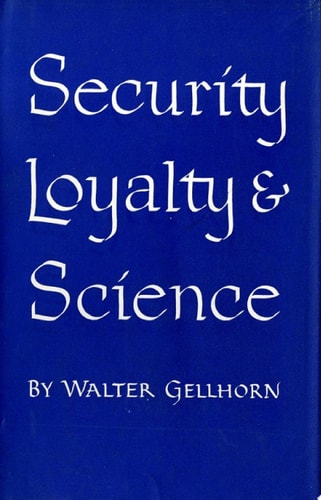
Security, Loyalty, and Science
0
0
As an Amazon Associate and affiliate partner, Menrva Books earns from qualifying purchases. Learn more
Author Description
Both sides of a sensitive problem are assessed by Professor Gellhorn in this penetrating analysis of national security and its effect upon scientific progress. The costs and advantages of secrecy in certain areas of science and the conflict between national safety and individual rights in the administration of our federal loyalty program are presented; all the arguments are objectively weighed. The book answers such questions as: Can young scientists be well trained when publication and teaching are not free? Have we gone far enough-or too far-in avoiding "security risks" in important scientific establishments? How does the federal drive against "potentially disloyal" persons actually work? Do "fear of the smear" and crude methods discourage public service by American scientists? This study, a unit of an investigation of control of subversive activities supported by grants from the Rockefeller Foundation, is based upon two years of research and numerous field interviews of scientists, administrators, defense officials, and educators. Security, Loyalty, and Science is a volume in the series Cornell Studies in Civil Liberty, of which Robert E. Cushman is advisory editor.
Menrva's Summary
THE THESIS
This book investigates the complex and often conflicting demands of national security, scientific progress, and individual liberties in the mid-20th century United States. Professor Walter Gellhorn meticulously examines the implications of secrecy in scientific research and the challenges posed by federal loyalty programs. He analyzes the costs and benefits of restricting scientific publication and teaching, the criteria for identifying and excluding
THE SCOPE MAP
- Analysis of the impact of national security measures on scientific freedom and progress.
- Examination of the federal loyalty program and its effect on individual rights.
- Discussion of the balance between secrecy in science and the need for open research and education.
- Inquiry into the methods used to screen for "security risks" in scientific institutions.
- Exploration of the "fear of the smear" and its discouragement of scientists in public service.
- Based on two years of research, including field interviews with scientists, administrators, defense officials, and educators.
- Part of the Cornell Studies in Civil Liberty series.
THE AUTHORITY PERSPECTIVE
This study is presented as a rigorous, objective assessment of a critical societal issue, aiming to weigh the arguments surrounding national security and scientific freedom. The author's background and the research methodology, including extensive interviews, suggest a thorough and evidence-based approach. The book's inclusion in the Cornell Studies in Civil Liberty series indicates its scholarly nature and its contribution to discussions on civil liberties in the context of government policy. It seeks to provide clarity on complex questions regarding the administration of loyalty programs and their impact on the scientific community.
Page Count:
312
Publication Date:
2019-03-15
Publisher:
Cornell University Press
ISBN-10:
1501740695
ISBN-13:
9781501740695
Politics
Science
History
Non-Fiction
Law
Community Tags
Similar Books