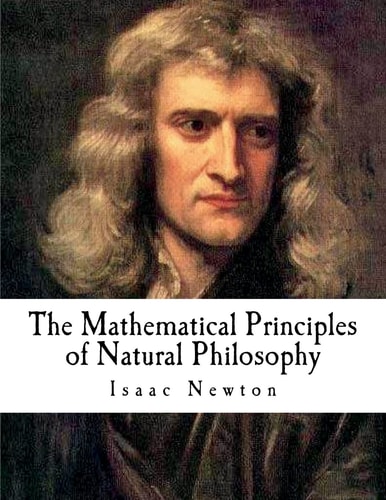
The Mathematical Principles of Natural Philosophy
0
0
As an Amazon Associate and affiliate partner, Menrva Books earns from qualifying purchases. Learn more
Author Description
The Mathematical Principles of Natural Philosophy: Philosophiae Naturalis Principia Mathematica by Isaac Newton and translated into English by Andrew Motte. Philosophiæ Naturalis Principia Mathematica (Latin for Mathematical Principles of Natural Philosophy), often referred to as simply the Principia, is a work in three books by Isaac Newton, in Latin, first published 5 July 1687. After annotating and correcting his personal copy of the first edition, Newton published two further editions, in 1713 and 1726. The Principia states Newton's laws of motion, forming the foundation of classical mechanics; Newton's law of universal gravitation; and a derivation of Kepler's laws of planetary motion (which Kepler first obtained empirically). The Principia is considered one of the most important works in the history of science. Sir Isaac Newton was an English mathematician, astronomer, theologian, author and physicist who is widely recognised as one of the most influential scientists of all time, and a key figure in the scientific revolution. His book Philosophiæ Naturalis Principia Mathematica ("Mathematical Principles of Natural Philosophy"), first published in 1687, laid the foundations of classical mechanics. Newton also made pathbreaking contributions to optics, and he shares credit with Gottfried Wilhelm Leibniz for developing the infinitesimal calculus.
Menrva's Summary
THE THESIS
The Principia establishes the fundamental laws governing the motion of bodies and the force of gravity. Sir Isaac Newton's seminal work, first published in 1687, lays out the foundational principles of classical mechanics through his three laws of motion. It further details his law of universal gravitation, providing a unified explanation for celestial and terrestrial motion. The text also derives Kepler's laws of planetary motion, demonstrating the mathematical underpinnings of astronomical observations.
THE SCOPE MAP
- Newton's Three Laws of Motion
- The Law of Universal Gravitation
- Derivations of Kepler's Laws of Planetary Motion
- Mathematical proofs and derivations supporting physical laws
- Foundational principles of classical mechanics
- Analysis of celestial and terrestrial motion
THE AUTHORITY PERSPECTIVE
The Principia is universally recognized as one of the most significant scientific works ever published, fundamentally shaping our understanding of the physical universe. Its rigorous mathematical approach and the groundbreaking laws it presented revolutionized physics and astronomy, forming the bedrock of scientific thought for centuries. The work's enduring influence is evident in its continued study and its role in inspiring subsequent scientific advancements. It remains a cornerstone text for anyone studying the history and principles of science.
Page Count:
374
Publication Date:
2018-08-02
Publisher:
CreateSpace Independent Publishing Platform
ISBN-10:
1724680447
ISBN-13:
9781724680440
Science
History
Non-Fiction
Gravitation
Mathematics
Classical Mechanics
Physics
Astronomy
Community Tags
Other Editions(2)

Similar Books