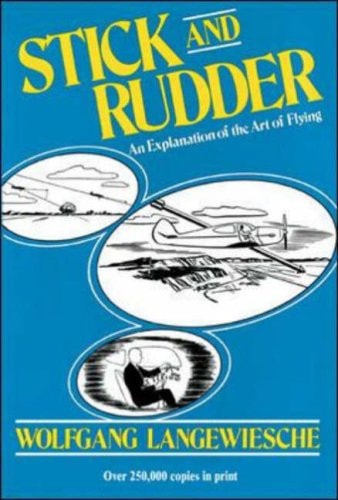
Stick and Rudder: An Explanation of the Art of Flying
0
0
As an Amazon Associate and affiliate partner, Menrva Books earns from qualifying purchases. Learn more
Author Description
Publisher's Note: Products purchased from Third Party sellers are not guaranteed by the publisher for quality, authenticity, or access to any online entitlements included with the product. WHAT'S IN STICK AND RUDDER: The invisible secret of all heavier-than-air flight: the Angle of Attack. What it is, and why it can't be seen. How lift is made, and what the pilot has to do with it. Why airplanes stall How do you know you're about to stall? The landing approach. How the pilot's eye functions in judging the approach. The visual clues by which an experienced pilot unconsciously judges: how you can quickly learn to use them. "The Spot that does not move." This is the first statement of this phenomenon. A foolproof method of making a landing approach across pole lines and trees. The elevator and the throttle. One controls the speed, the other controls climb and descent. Which is which? The paradox of the glide. By pointing the nose down less steeply, you descend more steeply. By pointing the nose down more steeply, you can glide further. What's the rudder for? The rudder does NOT turn the airplane the way a boat's rudder turns the boat. Then what does it do? How a turn is flown. The role of ailerons, rudder, and elevator in making a turn. The landing--how it's made. The visual clues that tell you where the ground is. The "tail-dragger" landing gear and what's tricky about it. This is probably the only analysis of tail-draggers now available to those who want to fly one. The tricycle landing gear and what's so good about it. A strong advocacy of the tricycle gear written at a time when almost all civil airplanes were taildraggers. Why the airplane doesn't feel the wind. Why the airplane usually flies a little sidewise.
Menrva's Summary
THE THESIS
This book dissects the fundamental principles of heavier-than-air flight, focusing on the often-overlooked 'Angle of Attack' as the key to understanding aircraft control. Wolfgang Langewiesche, an experienced aviator and writer, aims to demystify the art of flying by explaining the physics of lift, the causes and recognition of stalls, and the nuanced interplay between control surfaces and pilot perception. The work is structured as a practical guide, drawing on the author's deep knowledge to provide clear explanations and actionable advice for pilots.
THE SCOPE MAP
- The critical role of the Angle of Attack in generating lift and its invisibility to the naked eye.
- Detailed explanations of how lift is produced and the pilot's direct influence on it.
- Analysis of aircraft stalls, including how to anticipate and avoid them.
- Practical guidance on landing approaches, emphasizing visual cues for judging altitude and descent rate.
- The distinct functions of the elevator and throttle in controlling speed, climb, and descent.
- An exploration of the paradox of the glide: how changing pitch affects descent rate and glide distance.
- Clarification of the rudder's true function in turning, distinguishing it from a boat's rudder.
- A breakdown of how ailerons, rudder, and elevator work together to execute a turn.
- Techniques for judging ground proximity during landing using visual clues.
- Specific advice for landing 'tail-dragger' aircraft, highlighting their unique challenges.
- A strong endorsement of 'tricycle' landing gear and its advantages over traditional 'tail-dragger' configurations.
- An explanation of why aircraft do not directly 'feel' the wind and often fly slightly sideways.
THE AUTHORITY PERSPECTIVE
This seminal work is widely regarded as an essential text for pilots seeking a deeper understanding of flight dynamics beyond basic procedures. Langewiesche's clear, analytical prose breaks down complex aerodynamic concepts into accessible explanations, making it invaluable for both novice and experienced aviators. The book's enduring relevance lies in its focus on the pilot's perception and the fundamental physics that govern an aircraft's behavior. It is frequently recommended for its ability to foster a more intuitive and confident approach to flying.
Page Count:
400
Publication Date:
1990-09-22
Publisher:
McGraw-Hill Education
ISBN-10:
0070362408
ISBN-13:
9780070362406
Science & Technology
Non-Fiction
Science
Reference
How To
Aeronautics
Aviation
Pilot Training
Community Tags
Similar Books