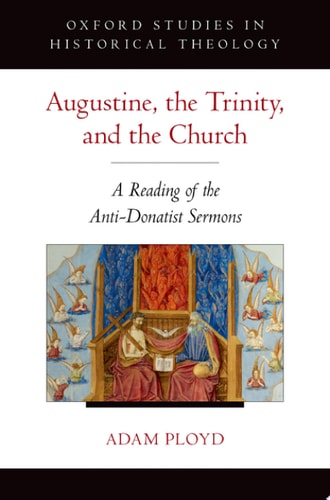
Augustine, the Trinity, and the Church: A Reading of the Anti-Donatist Sermons
0
0
As an Amazon Associate and affiliate partner, Menrva Books earns from qualifying purchases. Learn more
Author Description
The legacy of Augustine of Hippo (354-430) continues to shape Western Christian language about both the Trinity and the Church, yet scholars rarely treat these two topics as related in his work. In Augustine, the Trinity, and the Church, Adam Ployd argues that Augustine's ecclesiology drew upon his Trinitarian theology to a surprising degree; this connection appears most clearly in a series of sermons Augustine preached in 406-407 against the Donatists, the rival Christian communion in North Africa.As he preached, Augustine deployed scriptural interpretations derived from his Latin pro-Nicene predecessors - but he adapted these Trinitarian arguments to construct a vision of the charitable unity of the Catholic Church against the Donatists. To condemn the Donatists for separating from the body of Christ, for example, Augustine appropriated a pro-Nicene Christology that viewed Christ's body as the means for ascent to his divinity. Augustine also further identified the love that unites Christians to each other and to Christ in his body as the Holy Spirit, who gives to us what he eternally is as the mutual love of Father and Son. On the central issue of baptism, Augustine made the sacrament a Trinitarian act as Christ gives the Spirit to his own body.The book ultimately shows that, for Augustine, the unity and integrity of the Church depended not upon the purity of the bishops or the guarded boundaries of the community, but upon the work of the triune God who unites us to Christ through the love of the Spirit, whom Christ himself gives in baptism.
Menrva's Summary
THE THESIS
How does Augustine of Hippo integrate his Trinitarian theology into his ecclesiological arguments against the Donatist schism? Adam Ployd, a scholar of historical theology, examines a specific series of sermons from 406-407 to demonstrate that Augustine's vision of the Church is fundamentally rooted in his understanding of the triune God. By analyzing these texts, Ployd argues that Augustine utilized pro-Nicene Christological and pneumatological frameworks to define the unity of the Catholic Church as a reflection of divine love.
THE SCOPE MAP
What You Will Find
- An analysis of Augustine's anti-Donatist sermons from 406-407.
- A framework connecting Trinitarian theology to the nature of the Church.
- An examination of the role of the Holy Spirit in baptism and communal unity.
Scope Limits
- The study focuses primarily on the anti-Donatist sermons rather than Augustine's entire corpus.
- It does not provide a comprehensive biography of Augustine or a general history of the Donatist controversy.
THE AUTHORITY PERSPECTIVE
Scholars recognize this work as a significant contribution to the study of Augustinian theology, particularly for its focus on the intersection of his Trinitarian and ecclesiological thought. Readers frequently note the academic density of the prose, which is intended for specialists in historical theology and patristic studies.
Page Count:
240
Publication Date:
2015-07-01
Publisher:
Oxford University Press
ISBN-10:
0190212047
ISBN-13:
9780190212049
Religion
Church History
Augustine of Hippo
Theology
Donatists
Trinity
Sermons
Ecclesiology
Patristics
Trinitarian Theology
Community Tags
Similar Books