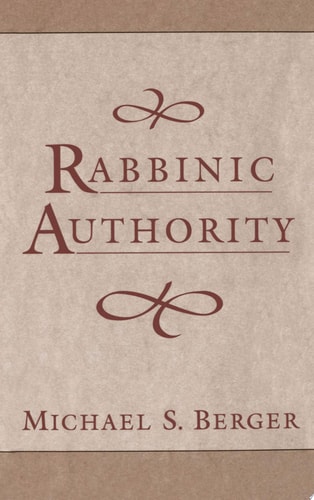
Rabbinic Authority
0
0
As an Amazon Associate and affiliate partner, Menrva Books earns from qualifying purchases. Learn more
Author Description
The Rabbis of the first five centuries of the Common Era loom large in the Jewish tradition. Until the modern period, Jews viewed the Rabbinic traditions as the authoritative contents of their covenant with God, and scholars debated the meanings of these ancient Sages words. Even after the eighteenth century, when varied denominations emerged within Judaism, each with its own approach to the tradition, the literary legacy of the talmudic Sages continued to be consulted.In this book, Michael S. Berger analyzes the notion of Rabbinic authority from a philosophical standpoint. He sets out a typology of theories that can be used to understand the authority of these Sages, showing the coherence of each, its strengths and weaknesses, and what aspects of the Rabbinic enterprise it covers. His careful and thorough analysis reveals that owing to the multifaceted character of the Rabbinic enterprise, no single theory is adequate to fully ground Rabbinic authority as traditionally understood.The final section of the book argues that the notion of Rabbinic authority may indeed have been transformed over time, even as it retained the original name. Drawing on the debates about legal hermeneutics between Ronald Dworkin and Stanley Fish, Berger introduces the idea that Rabbinic authority is not a strict consequence of a preexisting theory, but rather is embedded in a form of life that includes text, interpretation, and practices. Rabbinic authority is shown to be a nuanced concept unique to Judaism, in that it is taken to justify those sorts of activities which in turn actually deepen the authority itself.Students of Judaism and philosophers of religion in general will be intrigued by this philosophical examination of a central issue of Judaism, conducted with unprecedented rigor and refreshing creative insight.
Menrva's Summary
THE THESIS
This book investigates the philosophical foundations and historical evolution of Rabbinic authority within the Jewish tradition. Michael S. Berger, a scholar of Jewish studies, employs a rigorous analytical framework to evaluate how the authority of the talmudic Sages has been conceptualized and justified over centuries. By contrasting various theoretical models, he argues that no single theory fully captures the complexity of this authority, suggesting instead that it is deeply embedded in the lived practices and interpretive traditions of the Jewish community.
THE SCOPE MAP
What You Will Find
- A typology of philosophical theories regarding the nature of Rabbinic authority.
- An analysis of legal hermeneutics drawing on the work of Ronald Dworkin and Stanley Fish.
- A historical examination of the Rabbinic enterprise from the first five centuries of the Common Era through the modern period.
- A synthesis of how text, interpretation, and communal practice interact to sustain religious authority.
THE AUTHORITY PERSPECTIVE
Scholars and students of religion frequently note the academic density and philosophical rigor of Berger's analysis. Experts highlight this work as a significant contribution to the study of Jewish legal theory and the philosophy of religious authority.
Page Count:
240
Publication Date:
1998-10-15
Publisher:
Oxford University Press
ISBN-10:
0195122690
ISBN-13:
9780195122695
History
Religion
Philosophy
Amoraim
Judaism
Talmud
Theology
Criticism history
Rabbis
Tannaim
Community Tags
Other Editions(3)


Similar Books




Reader Comments
Share Your Thoughts
No comments yet. Be the first to share your thoughts!