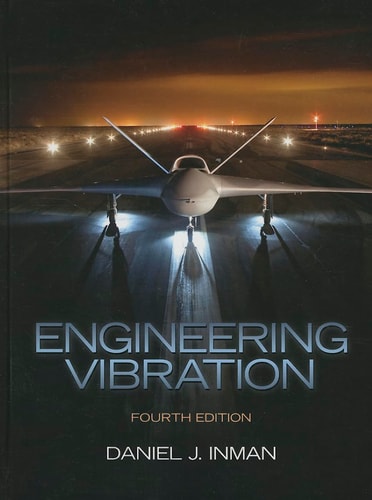
Engineering Vibration
0
0
As an Amazon Associate and affiliate partner, Menrva Books earns from qualifying purchases. Learn more
Author Description
For one/two-semester introductory courses in vibration for undergraduates in Mechanical Engineering, Civil Engineering, Aerospace Engineering and Mechanics Serving as both a text and reference manual, Engineering Vibration, 4e, connects traditional design-oriented topics, the introduction of modal analysis, and the use of MATLAB, Mathcad, or Mathematica. The author provides an unequaled combination of the study of conventional vibration with the use of vibration design, computation, analysis and testing in various engineering applications. Teaching and Learning Experience To provide a better teaching and learning experience, for both instructors and students, this program will: Apply Theory and/or Research: An unequaled combination of the study of conventional vibration with the use of vibration design, computation, analysis and testing in various engineering applications. Prepare Students for their Career: Integrated computational software packages provide students with skills required by industry.
Menrva's Summary
THE THESIS
This textbook aims to provide a comprehensive understanding of vibration analysis for undergraduate engineering students. It serves as both a text and a reference, integrating traditional design-oriented topics with modal analysis and computational tools like MATLAB, Mathcad, or Mathematica. The book offers a unique blend of conventional vibration study and practical application in design, computation, analysis, and testing across various engineering disciplines. Its approach is designed to equip students with industry-relevant skills through the use of integrated computational software.
THE SCOPE MAP
- Covers conventional vibration theory and design principles.
- Introduces modal analysis techniques.
- Integrates computational software packages (MATLAB, Mathcad, Mathematica) for analysis and testing.
- Applies vibration concepts to Mechanical, Civil, and Aerospace Engineering applications.
- Connects theoretical study with practical engineering design, computation, analysis, and testing.
THE AUTHORITY PERSPECTIVE
This text is structured to provide a robust foundation in vibration engineering, blending theoretical concepts with practical computational applications. The integration of software tools like MATLAB is intended to prepare students for the demands of modern engineering practice. The book's approach emphasizes the application of vibration principles across multiple engineering fields, suggesting a broad utility for students and professionals alike.
Page Count:
707
Publication Date:
2014-01-01
Publisher:
Pearson
ISBN-10:
0132871696
ISBN-13:
9780132871693
Science
Non-Fiction
Engineering
Aerospace Engineering
Computational Methods
Civil Engineering