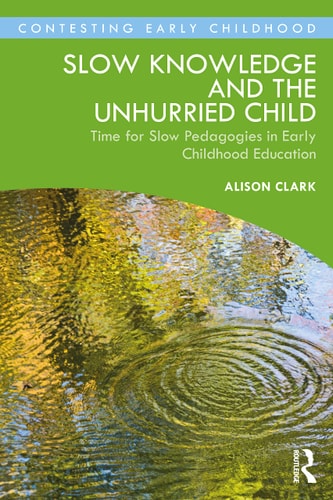
Slow Knowledge and the Unhurried Child: Time for Slow Pedagogies in Early Childhood Education
0
0
As an Amazon Associate and affiliate partner, Menrva Books earns from qualifying purchases. Learn more
Author Description
This book explores the relationship with time in early childhood by arguing for the valuing of slow pedagogies and slow knowledge. Alison Clark points to alternative practices in Early Childhood Education and Care that enable a different pace and rhythm, against the backdrop of the acceleration in early childhood and the proliferation of testing and measurement. Diverse approaches are explored to enable an 'unhurried child' and less hurried adults. Slow Knowledge and the Unhurried Child is divided in three parts. Part 1, Reasons to be slow, looks at the pressures in Early Childhood Education and Care to speed up and for children to be 'readied' for the next stage. The book then explores different relationships with time for young children and educators. Part 2, Slow pedagogies and practices, explore some of the forms slow practices can take including outdoors, in the studio, in everyday routines, through stories, in pedagogical documentation and in 'slow' research. Part 3, Moving forward, shows what a 'timefull' approach to ECEC can look like, whilst debating the challenges and possibilities that exist. The book serves as a catalyst for urgent discussion about the need to slow down in early childhood education and teacher education and explores case studies of where slow early childhood education are already happening. It will be a key reading for researchers, practitioners and policy-makers about the relationship with time in early childhood and the importance of taking a longer view.
Menrva's Summary
THE THESIS
This book investigates the pervasive acceleration in early childhood education and argues for the adoption of slow pedagogies and slow knowledge. Alison Clark, drawing on alternative practices within Early Childhood Education and Care, proposes methods to foster a more deliberate pace and rhythm, counteracting the pressures of testing and measurement. The work is structured into three parts: 'Reasons to be slow,' which examines the impetus to speed up and 'ready' children; 'Slow pedagogies and practices,' exploring diverse slow approaches in various settings like outdoor play, studios, routines, storytelling, documentation, and research; and 'Moving forward,' which discusses the challenges and possibilities of a 'timefull' approach to ECEC.
THE SCOPE MAP
- Exploration of the pressures in Early Childhood Education and Care to accelerate learning and 'ready' children.
- Examination of alternative practices that enable a different pace and rhythm in early childhood.
- Discussion of 'slow knowledge' and its value in early childhood development.
- Case studies of slow pedagogies in practice, including outdoor settings, studios, and everyday routines.
- Analysis of slow approaches through storytelling, pedagogical documentation, and 'slow' research methods.
- Consideration of a 'timefull' approach to Early Childhood Education and Care (ECEC).
- Debate on the challenges and possibilities of implementing slow education.
- Focus on the relationship with time for both young children and educators.
THE AUTHORITY PERSPECTIVE
The book serves as a catalyst for urgent discussion regarding the necessity of slowing down in early childhood education and teacher education. It is positioned as key reading for researchers, practitioners, and policymakers interested in the temporal dimensions of early childhood and the importance of a long-term perspective. The work aims to foster a critical dialogue about current trends and advocate for a more mindful and unhurried approach to child development and education.
Page Count:
160
Publication Date:
2022-12-30
Publisher:
Taylor & Francis Group
ISBN-10:
0367508818
ISBN-13:
9780367508814
Non-Fiction
Philosophy
Self-help
Pedagogy
Educational Philosophy
Community Tags
Similar Books