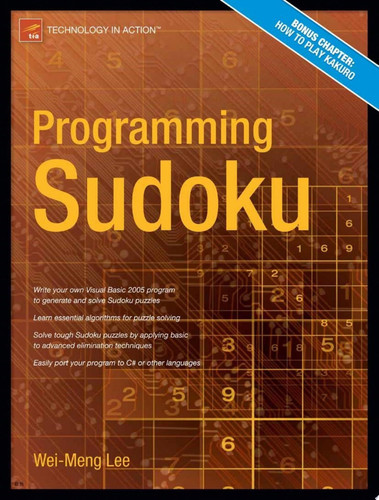
Programming Sudoku
0
0
As an Amazon Associate and affiliate partner, Menrva Books earns from qualifying purchases. Learn more
Author Description
Sudoku is a wildly popular puzzle game. Sudoku puzzles are 9x9 grids, and each square in the grid consists of a 3x3 subgrid called a region. Your goal is to fill in the squares so that each column, row, and region contains the numbers 1 through 9 exactly once. And some squares already contain numbers or symbols, which lend clues toward the solution. Programming Sudoku provides you with great approaches to building and solving Sudoku and other similar puzzles. Using ingenious artificial intelligence and game theory techniques, you’ll learn how to get a computer to solve these puzzles for you. This is a fun, intriguing read, whether you're a novice or advanced programmer. It acknowledges the.NET platform as a base, but you’ll find this book interesting whatever your programming background. The core techniques in the book enable you to solve Sudoku on any programming platform.
Menrva's Summary
THE THESIS
This book explores the application of artificial intelligence and game theory to the construction and solution of Sudoku puzzles. Wei-Meng Lee, an experienced programmer, guides readers through building and solving Sudoku and similar puzzles. The book leverages ingenious AI and game theory techniques to enable computers to solve these challenges. While acknowledging the .NET platform, the core techniques are transferable to any programming environment, making it valuable for programmers of all backgrounds.
THE SCOPE MAP
- Approaches to building and solving Sudoku puzzles.
- Application of artificial intelligence techniques for puzzle solving.
- Utilization of game theory principles in puzzle automation.
- Core techniques applicable across various programming platforms.
- Examples and explanations suitable for novice and advanced programmers.
THE AUTHORITY PERSPECTIVE
The book is presented as an intriguing read for programmers interested in puzzles, regardless of their experience level. It emphasizes the practical application of AI and game theory to a popular game, suggesting a focus on problem-solving and algorithmic thinking. The transferable nature of the core techniques implies a broad appeal beyond specific platform users.
Page Count:
232
Publication Date:
2008-11-01
Publisher:
Apress
ISBN-10:
1430213795
ISBN-13:
9781430213796
Science & Technology
Non-Fiction
Game theory
Puzzles
Programming