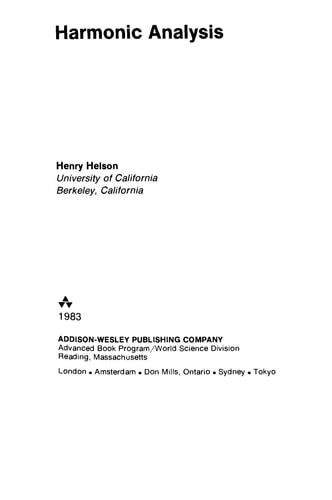
Harmonic Analysis
0
0
As an Amazon Associate and affiliate partner, Menrva Books earns from qualifying purchases. Learn more
Author Description
The reader is assumed to know the elementary part of complex function theory, general topology, integration, and linear spaces. All the needed information is contained in a usual first-year graduate course on analysis. These prerequisites are modest but essential. To be sure there is a big gap between learning the Banach-Steinhaus theorem, for example, and applying it to a real problem. Filling that gap is one of the objectives of this book. It is a natural objective, because integration theory and functional analysis to a great extent developed in response to the problems of Fourier series! The exposition has been condensed somewhat by relegating proofs of some technical points to the problem sets. Other problems give results that are needed in subsequent sections; and many problems simply present interesting results of the subject that are not otherwise covered. Problems range in difficulty from very simple to very hard. The system of numeration is simple: Sec. 3. 2 is the second section of Chapter 3. The second section of the current chapter is Sec. 2. Formula (3. 2) is the second formula of Sec. 3, of the current chapter unless otherwise mentioned. With pleasure I record the debt to my notes from a course on Real Variables given by R. Salem in 1945. I wish to thank R. Fefferman, Y. Katznelson, and A. 6 Cairbre for sympathetic criticism of the manuscript. Mr. Carl Harris of the Addison-Wesley Publishing Company has been most helpful in bringing the book to publication.
Menrva's Summary
THE THESIS
This text investigates the application of functional analysis and integration theory to the foundational problems of Fourier series. The author, Henry Helson, provides a bridge between abstract mathematical theorems and their practical utility in analysis. By assuming a baseline knowledge of complex function theory and topology, the book focuses on the transition from theoretical understanding to problem-solving proficiency within the context of graduate-level mathematics.
THE SCOPE MAP
What You Will Find
- Integration theory and its historical development in response to Fourier series
- Application of functional analysis theorems to concrete mathematical problems
- A comprehensive problem set ranging from introductory exercises to advanced research challenges
- Theoretical frameworks for linear spaces and general topology
THE AUTHORITY PERSPECTIVE
Readers frequently note the academic density of the prose and the necessity of the stated prerequisites for successful engagement with the material. Experts highlight this as a foundational text for graduate students seeking to connect abstract analysis with classical Fourier theory.
Page Count:
190
Publication Date:
1983-01-01
Publisher:
Addison-Wesley
ISBN-10:
0201127520
ISBN-13:
9780201127522
Mathematics
textbook
Analysis
Harmonic Analysis
Functional analysis
Fourier Analysis