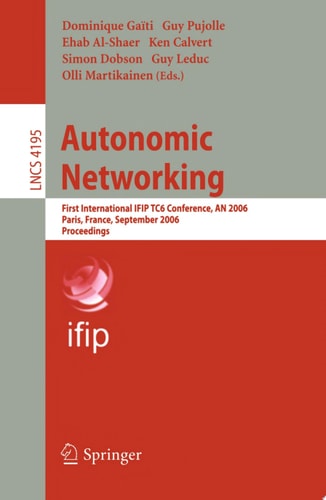
Autonomic Networking
0
0
As an Amazon Associate and affiliate partner, Menrva Books earns from qualifying purchases. Learn more
Author Description
The autonomic communication paradigm has been defined mainly through the Autonomic Communications Forum (ACF) and particularly as follows: Autonomic communication is centered on selfware – an innovative approach to perform known and emerging tasks of a network control plane, both end-to-end and middle box communication-based. Selfware assures the capacity to evolve; however, it requires generic network instrumentation. Selfware principles and technologies borrow largely from well-established research on distributed systems, fault tolerance among others, from emerging research on non-conventional networking (multihop ad hoc, sensor, peer-to-peer, group communication, etc. ), and from similar initiatives, such as Autonomic Computing of IBM, Cognitive Network of DARPA, Harmonious Computing of Hitachi, Resonant Networking of NTT, etc. A visionary network would be able to (a) configure and re-configure itself, (b) identify its operational state and take actions to drive itself to a desired stable state and finally (c) organize the allocation and distribution of its resources. To build such a network, it is necessary to go beyond the improvement of techniques and algorithms by using a new concept, the knowledge plane. The knowledge plane is able to collect information available in the network to provide other elements of the network with services and advice and make the network perform what it is supposed to. There are many objectives to the configuration and reconfiguration of the network, from the optimization of resources to the use of best available techniques in order to offer the most appropriate service, best adapted to the t- minal capabilities.
Menrva's Summary
THE THESIS
This book investigates the paradigm of autonomic communication, focusing on the concept of 'selfware' as a novel approach to network control plane tasks. It explores how selfware, by borrowing from distributed systems and non-conventional networking research, can enable networks to autonomously configure, reconfigure, identify operational states, and manage resources. The core argument is that achieving such visionary networks requires a new concept: the knowledge plane, which collects and disseminates information to guide network performance and resource allocation.
THE SCOPE MAP
- The definition and principles of autonomic communication and selfware.
- Exploration of generic network instrumentation required for selfware.
- Connections to research in distributed systems and fault tolerance.
- Discussion of non-conventional networking (ad hoc, sensor, P2P, etc.).
- Comparison with related initiatives like IBM's Autonomic Computing and DARPA's Cognitive Network.
- The concept and function of the knowledge plane in autonomic networking.
- Objectives for network configuration and reconfiguration, including resource optimization and service adaptation.
THE AUTHORITY PERSPECTIVE
This book is positioned as a foundational text exploring the emerging field of autonomic networking, likely appealing to researchers and practitioners in network engineering and computer science. The detailed exposition of selfware and the knowledge plane suggests a focus on theoretical underpinnings and architectural concepts, rather than practical implementation guides. Its origins in academic forums and contributions from leading researchers indicate a scholarly approach to defining and advancing the field.
Page Count:
316
Publication Date:
2006-09-29
Publisher:
Springer Nature
ISBN-10:
354045893X
ISBN-13:
9783540458937
Science & Technology
Non-Fiction
Science
Computer Science
Computer Engineering
Networking
Community Tags
Similar Books