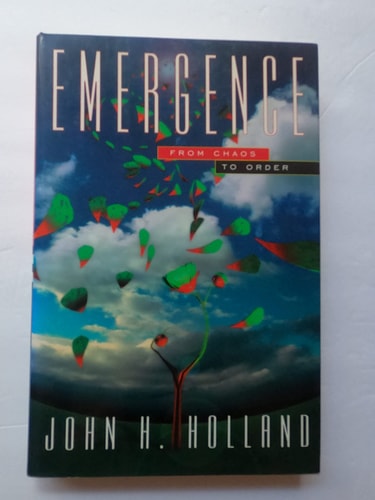
Emergence: From Chaos to Order
0
0
As an Amazon Associate and affiliate partner, Menrva Books earns from qualifying purchases. Learn more
Author Description
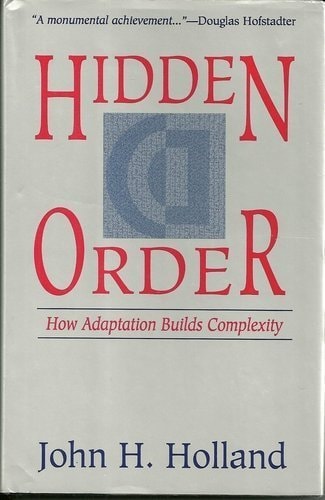
In this important book, John H. Holland dramatically shows us that the “emergence” of order from disorder has much to teach us about life, mind and organizations. Creative activities in both the arts and the sciences depend upon an ability to model the world. The most creative of those models exhibits emergent properties, so that “what comes out is more than what goes in.” From the ingenious checkers-playing computer that started beating its creator in game after game, to the emotive creations of the poet, Emergence shows that Holland's theory successfully predicts many complex behaviors in art and science.
Menrva's Summary
THE THESIS
This book investigates the mechanisms by which complex order arises from simple, chaotic systems and how these emergent properties define the nature of life, mind, and organizational structures. John H. Holland, a pioneer in the field of complex adaptive systems, utilizes his extensive background in computer science and cognitive modeling to propose a unified framework for understanding emergence. He argues that the most effective models in both the arts and sciences are those that exhibit emergent behaviors, where the output of a system transcends the sum of its individual components. By analyzing diverse phenomena ranging from game-playing algorithms to human creativity, Holland demonstrates how simple rules can generate sophisticated, unpredictable outcomes.
THE SCOPE MAP
What You Will Find
- Analysis of complex adaptive systems and their underlying rule-based structures
- Theoretical frameworks for modeling emergence in biological and artificial systems
- Case studies ranging from checkers-playing computer programs to poetic creation
- Exploration of how emergent properties influence organizational behavior and cognitive development
THE AUTHORITY PERSPECTIVE
Experts recognize this work as a foundational text for understanding the mechanics of complexity and adaptive systems. Readers frequently note the technical depth of the prose, which balances abstract theoretical concepts with practical examples from computer science and biology.
Page Count:
272
Publication Date:
1998-01-06
Publisher:
Addison-Wesley
ISBN-10:
0201149435
ISBN-13:
9780201149432
Science
Chaotic behavior in systems
Systems Theory
Complexity Theory