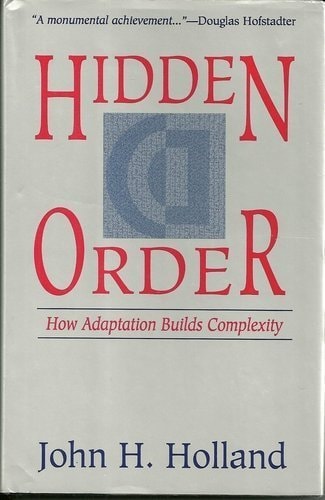
Hidden Order: How Adaptation Builds Complexity
0
0
As an Amazon Associate and affiliate partner, Menrva Books earns from qualifying purchases. Learn more
Author Description
Holland, known for his pioneering efforts in genetic algorithms and the new science of complexity, outlines some principles and demonstrates some procedures and approaches of his recent work in the emerging field of complex adaptive systems, which may someday help model and explain biological, social, environmental, and other systems that change. The text was presented as a lecture series at the Santa Fe Institute in early 1994, and is the first of a series of volumes from the annual lectures. Annotation copyright Book News, Inc. Portland, Or.
Menrva's Summary
THE THESIS
How do complex adaptive systems emerge from simple rules of interaction and adaptation? John H. Holland, a pioneer in genetic algorithms and complexity science, investigates the underlying mechanisms that allow systems to evolve and maintain order. Drawing on his research at the Santa Fe Institute, Holland proposes a framework for understanding how individual agents within a system interact to produce emergent, global behaviors across biological, social, and environmental domains.
THE SCOPE MAP
What You Will Find
- Principles of complex adaptive systems and their structural components
- Methodologies for modeling system evolution through genetic algorithms
- Case studies demonstrating the application of adaptive rules in diverse environments
- Theoretical frameworks for predicting system behavior in changing conditions
THE AUTHORITY PERSPECTIVE
Experts recognize this work as a foundational text for understanding the early development of complexity science and computational modeling. Readers frequently note the academic density of the prose, which requires a foundational understanding of systems theory to fully grasp the author's mathematical arguments.
Page Count:
185
Publication Date:
1995-08-21
Publisher:
Basic Books
ISBN-10:
0201407930
ISBN-13:
9780201407938
Science
Mathematics
Computer Science
Systems Theory
Adaptation Biology
Biology
Control systems
Complexity Theory
Community Tags
Similar Books