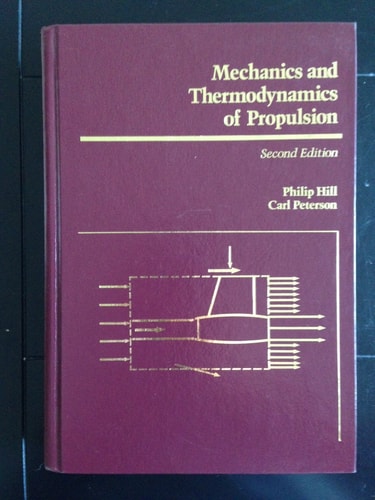
Mechanics and Thermodynamics of Propulsion
0
0
As an Amazon Associate and affiliate partner, Menrva Books earns from qualifying purchases. Learn more
Author Description
In this textbook, the authors show that a few fundamental principles can provide students of mechanical and aeronautical engineering with a deep understanding of all modes of aircraft and spacecraft propulsion. The book also demonstrates how these fundamental principles can lead directly to useful quantitative assessments of performance as well as possibilities for improvement.
Menrva's Summary
THE THESIS
This text investigates the application of fundamental physical principles to the analysis and design of various aircraft and spacecraft propulsion systems. Authors Philip G. Hill and Carl R. Peterson, both established experts in mechanical and aeronautical engineering, utilize a rigorous analytical framework to bridge the gap between theoretical thermodynamics and practical engine performance. By focusing on core governing equations, the authors provide a methodology for evaluating existing propulsion technologies and identifying potential avenues for engineering optimization.
THE SCOPE MAP
What You Will Find
- Comprehensive analysis of gas turbine, ramjet, and rocket propulsion cycles
- Quantitative methodologies for assessing engine performance and efficiency
- Application of thermodynamic laws to fluid flow and combustion processes
- Mathematical models for evaluating propulsion system improvements
THE AUTHORITY PERSPECTIVE
Experts and educators frequently cite this work as a foundational text for undergraduate and graduate students in aerospace engineering. Readers often note the high level of mathematical rigor and the systematic approach to complex propulsion problems.
Page Count:
768
Publication Date:
1991-09-17
Publisher:
Pearson
ISBN-10:
0201146592
ISBN-13:
9780201146592
Engineering
textbook
Physics
Aeronautics
Thermodynamics