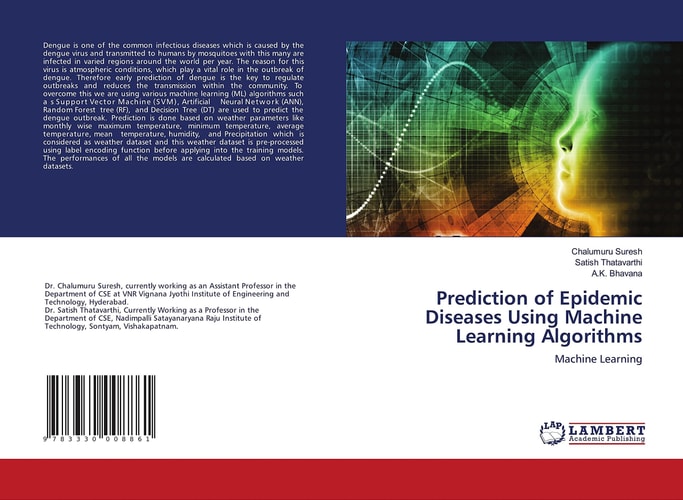
Prediction of Epidemic Diseases Using Machine Learning Algorithms
0
0
As an Amazon Associate and affiliate partner, Menrva Books earns from qualifying purchases. Learn more
Author Description
Dengue is one of the common infectious diseases which is caused by the dengue virus and transmitted to humans by mosquitoes with this many are infected in varied regions around the world per year. The reason for this virus is atmospheric conditions, which play a vital role in the outbreak of dengue. Therefore early prediction of dengue is the key to regulate outbreaks and reduces the transmission within the community. To overcome this we are using various machine learning (ML) algorithms such as Support Vector Machine (SVM), Artificial Neural Network (ANN), Random Forest tree (RF), and Decision Tree (DT) are used to predict the dengue outbreak. Prediction is done based on weather parameters like monthly wise maximum temperature, minimum temperature, average temperature, mean temperature, humidity, and Precipitation which is considered as weather dataset and this weather dataset is pre-processed using label encoding function before applying into the training models. The performances of all the models are calculated based on weather datasets.
Menrva's Summary
THE THESIS
This book investigates the application of machine learning algorithms for the early prediction of epidemic diseases, specifically focusing on dengue. The authors address the challenge posed by dengue, a mosquito-borne viral infection exacerbated by atmospheric conditions, and propose machine learning models to forecast outbreaks. By utilizing weather parameters such as temperature and humidity, the study aims to provide a predictive framework to mitigate transmission within communities. The research employs algorithms like Support Vector Machine (SVM), Artificial Neural Network (ANN), Random Forest (RF), and Decision Tree (DT), with pre-processing of weather data via label encoding before model training and performance evaluation.
THE SCOPE MAP
- Application of machine learning algorithms (SVM, ANN, Random Forest, Decision Tree) for epidemic prediction.
- Focus on dengue as a case study for infectious disease outbreak forecasting.
- Utilization of weather parameters (maximum temperature, minimum temperature, average temperature, mean temperature, humidity, precipitation) as predictive data.
- Pre-processing of weather data using label encoding.
- Performance evaluation of different machine learning models based on weather datasets.
- Aim to provide early prediction of dengue outbreaks to reduce community transmission.
THE AUTHORITY PERSPECTIVE
This work presents a focused application of machine learning techniques to a critical public health issue, dengue prediction. The methodology described, involving various established ML algorithms and weather data, suggests a data-driven approach to forecasting disease outbreaks. The study's emphasis on early prediction indicates its potential utility for public health interventions and resource allocation.
Page Count:
68
Publication Date:
2020-01-01
Publisher:
LAP LAMBERT Academic Publishing
ISBN-10:
3330008865
ISBN-13:
9783330008861
Non-Fiction
Science
Data Science
Public Health
Machine Learning
Epidemiology
Community Tags
Similar Books