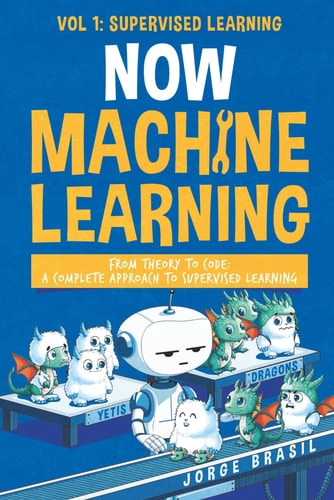
Now Machine Learning Vol1: Supervised Learning: Mastering Regression, Classification, and Predictive Modeling with Python
0
0
As an Amazon Associate and affiliate partner, Menrva Books earns from qualifying purchases. Learn more
Author Description
What if insuring dragons against fire damage or unicorns from magical mishaps could unlock the secrets of machine learning? Hello, we invite you to join our data science team at AllMyth Coverage, an insurance company that covers mythical creatures. Dragons, unicorns, and plenty of odd edge cases included. Instead of listing algorithms in isolation, we put models to work in a commercial setting. Together, we build, train, and analyze supervised learning models for classification and regression, always connecting the mathematics to the code and to real business decisions. We cover risk classification using decision trees, random forests, and gradient boosted trees. For regression, we explore linear, weighted, and Bayesian regression. We also tackle churn prediction using perceptrons, logistic regression, and neural networks. Along the way, we deal with overfitting, hyperparameter tuning, regularization techniques such as L1, L2, and dropout, and practical feature engineering. Every model is derived step by step, explained with hand worked examples, and then implemented in code. This book assumes basic knowledge of linear algebra, calculus, probability and statistics, and Python. It is written for readers who want to understand how supervised learning models actually work, not just how to use them.
Menrva's Summary
THE THESIS
This book investigates how supervised machine learning models can be applied to real-world business problems, specifically within the context of an insurance company for mythical creatures. The author, Jorge Brasil, uses the premise of insuring dragons and unicorns to demonstrate the practical application of classification and regression models. The book details the step-by-step process of building, training, and analyzing these models, connecting mathematical concepts directly to Python code and business decisions. It covers a range of techniques including decision trees, random forests, gradient boosted trees, linear regression, logistic regression, and neural networks, while also addressing crucial aspects like overfitting, hyperparameter tuning, regularization, and feature engineering.
THE SCOPE MAP
- Risk classification using decision trees, random forests, and gradient boosted trees.
- Regression analysis including linear, weighted, and Bayesian regression.
- Churn prediction models such as perceptrons, logistic regression, and neural networks.
- Techniques for handling overfitting, including hyperparameter tuning and regularization (L1, L2, dropout).
- Practical feature engineering strategies.
- Step-by-step derivation of models with hand-worked examples.
- Implementation of models in Python code.
- Application of models within a commercial insurance setting for mythical creatures.
THE AUTHORITY PERSPECTIVE
The book is presented as a practical guide for readers who want to understand the inner workings of supervised learning models rather than just their usage. It aims to bridge the gap between theoretical mathematics and practical coding by using relatable, albeit fantastical, business scenarios. The detailed, step-by-step approach with code implementation suggests a thorough and accessible learning experience for those with a foundational knowledge of statistics, calculus, and Python.
Page Count:
482
Publication Date:
2025-12-23
Publisher:
Independently published
ISBN-13:
9798241044891
Science & Technology
Science
Non-Fiction
Data Science
Classification
Python
Machine Learning
Community Tags
Similar Books