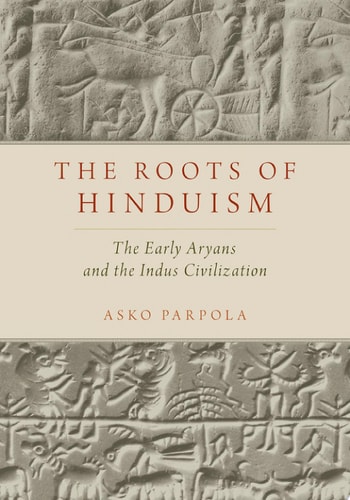
Roots of Hinduism
0
0
As an Amazon Associate and affiliate partner, Menrva Books earns from qualifying purchases. Learn more
Author Description
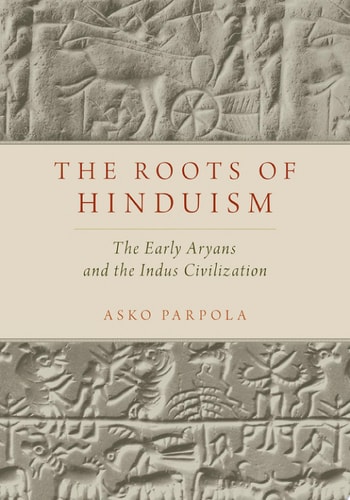
Hinduism has two major roots. The more familiar is the religion brought to South Asia in the second millennium BCE by speakers of Aryan or Indo-Iranian languages, a branch of the Indo-European language family. Another, more enigmatic, root is the Indus civilization of the third millennium BCE, which left behind exquisitely carved seals and thousands of short inscriptions in a long-forgotten pictographic script. Discovered in the valley of the Indus River in the early 1920s, the Indus civilization had a population estimated at one million people, in more than 1000 settlements, several of which were cities of some 50,000 inhabitants. With an area of nearly a million square kilometers, the Indus civilization was more extensive than the contemporaneous urban cultures of Mesopotamia and Egypt. Yet, after almost a century of excavation and research the Indus civilization remains little understood. How might we decipher the Indus inscriptions? What language did the Indus people speak? What deities did they worship?Asko Parpola has spent fifty years researching the roots of Hinduism to answer these fundamental questions, which have been debated with increasing animosity since the rise of Hindu nationalist politics in the 1980s. In this pioneering book, he traces the archaeological route of the Indo-Iranian languages from the Aryan homeland north of the Black Sea to Central, West, and South Asia. His new ideas on the formation of the Vedic literature and rites and the great Hindu epics hinge on the profound impact that the invention of the horse-drawn chariot had on Indo-Aryan religion. Parpola's comprehensive assessment of the Indus language and religion is based on all available textual, linguistic and archaeological evidence, including West Asian sources and the Indus script. The results affirm cultural and religious continuity to the present day and, among many other things, shed new light on the prehistory of the key Hindu goddess Durga and her Tantric cult.
Menrva's Summary
THE THESIS
This book investigates the dual origins of Hinduism by examining the intersection of the Indus civilization and the arrival of Indo-Iranian language speakers in South Asia. Asko Parpola, a scholar with five decades of research experience, synthesizes archaeological, linguistic, and textual evidence to address the long-standing mysteries surrounding the Indus script, the language of its people, and the evolution of Vedic religious practices. He argues that the introduction of the horse-drawn chariot served as a catalyst for significant shifts in Indo-Aryan religious structures and the subsequent development of Hindu epics.
THE SCOPE MAP
What You Will Find
- Analysis of the Indus civilization's urban development and material culture.
- Linguistic reconstruction of Indo-Iranian language migration patterns.
- Examination of the relationship between the Indus script and early Vedic literature.
- Historical investigation into the origins of the goddess Durga and Tantric traditions.
Scope Limits
- The text does not provide a definitive, universally accepted decipherment of the entire Indus script.
- It focuses primarily on the pre-Vedic and Vedic periods rather than modern Hindu theological practice.
THE AUTHORITY PERSPECTIVE
Scholars and historians recognize this work as a comprehensive synthesis of decades of research into South Asian prehistory. Readers frequently note the academic density of the prose, which requires a foundational understanding of historical linguistics and archaeological methodology to fully appreciate.
Page Count:
384
Publication Date:
1900-01-01
Publisher:
Fisicalbook
ISBN-10:
0190226927
ISBN-13:
9780190226923
History
Religion
Archaeology
Indus Civilization
Hinduism
Linguistics
Community Tags
Similar Books