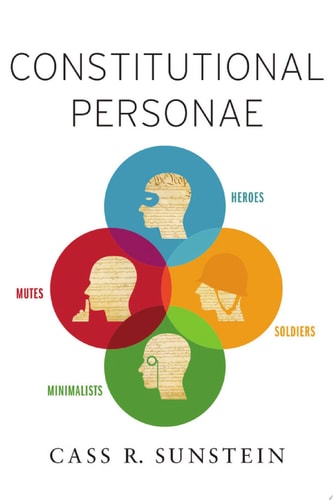
Constitutional Personae: Heroes, Soldiers, Minimalists, and Mutes
0
0
As an Amazon Associate and affiliate partner, Menrva Books earns from qualifying purchases. Learn more
Author Description
Since America's founding, the U.S. Supreme Court had issued a vast number of decisions on a staggeringly wide variety of subjects. And hundreds of judges have occupied the bench. Yet as Cass R. Sunstein, the eminent legal scholar and bestselling co-author of Nudge, points out, almost every one of the Justices fits into a very small number of types regardless of ideology: the hero, the soldier, the minimalist, and the mute. Heroes are willing to invoke the Constitution to invalidate state laws, federal legislation, and prior Court decisions. They loudly embrace first principles and are prone to flair, employing dramatic language to fundamentally reshape the law. Soldiers, on the other hand, are skeptical of judicial power, and typically defer to decisions made by the political branches. Minimalists favor small steps and only incremental change. They worry that bold reversals of long-established traditions may be counterproductive, producing a backlash that only leads to another reversal. Mutes would rather say nothing at all about the big constitutional issues, and instead tend to decide cases on narrow grounds or keep controversial cases out of the Court altogether by denying standing. As Sunstein shows, many of the most important constitutional debates are in fact contests between the four Personae. Whether the issue involves slavery, gender equality, same-sex marriage, executive power, surveillance, or freedom of speech, debates have turned on choices made among the four Personae--choices that derive as much from psychology as constitutional theory. Sunstein himself defends a form of minimalism, arguing that it is the best approach in a self-governing society of free people. More broadly, he casts a genuinely novel light on longstanding disputes over the proper way to interpret the constitution, demonstrating that behind virtually every decision and beneath all of the abstract theory lurk the four Personae. By emphasizing the centrality of character types, Sunstein provides a new way to understand the Court.
Menrva's Summary
THE THESIS
How do the psychological and character-based predispositions of Supreme Court Justices dictate the trajectory of American constitutional law? Cass R. Sunstein, a prominent legal scholar, argues that judicial decision-making is less a product of pure legal theory and more a reflection of four distinct archetypes: the hero, the soldier, the minimalist, and the mute. By categorizing Justices into these specific personae, Sunstein provides a framework to understand why the Court consistently approaches major societal issues through predictable, recurring patterns of behavior.
THE SCOPE MAP
What You Will Find
- A typology of four judicial character types: Heroes, Soldiers, Minimalists, and Mutes.
- Analysis of historical and contemporary Supreme Court cases including slavery, gender equality, and executive power.
- An argument for judicial minimalism as a preferred strategy for democratic stability.
Scope Limits
- The text does not provide an exhaustive history of every Supreme Court Justice.
- It does not offer a comprehensive legal manual for constitutional litigation.
THE AUTHORITY PERSPECTIVE
Legal scholars and political scientists frequently cite this work as a useful heuristic for simplifying complex judicial behavior into manageable categories. Readers often note that while the prose is accessible to non-lawyers, it maintains a high level of analytical rigor suitable for academic study.
Page Count:
192
Publication Date:
2015-01-01
Publisher:
Oxford University Press
ISBN-10:
0190222697
ISBN-13:
9780190222697
Law
Supreme Court
Constitutional Law
Professional Career & Trade
Legal Theory
United States
Constitutions
Community Tags
Similar Books