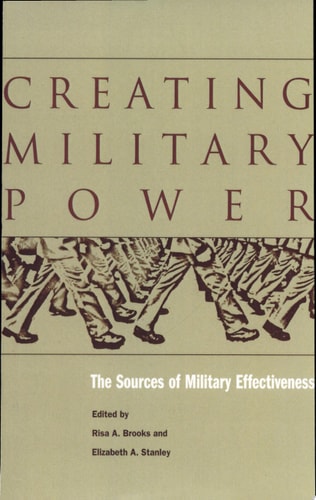
Creating Military Power: The Sources of Military Effectiveness
0
0
As an Amazon Associate and affiliate partner, Menrva Books earns from qualifying purchases. Learn more
Author Description
Creating Military Power examines how societies, cultures, political structures, and the global environment affect countries' military organizations. Unlike most analyses of countries' military power, which focus on material and basic resources—such as the size of populations, technological and industrial base, and GNP—this volume takes a more expansive view. The study's overarching argument is that states' global environments and the particularities of their cultures, social structures, and political institutions often affect how they organize and prepare for war, and ultimately impact their effectiveness in battle. The creation of military power is only partially dependent on states' basic material and human assets. Wealth, technology, and human capital certainly matter for a country's ability to create military power, but equally important are the ways a state uses those resources, and this often depends on the political and social environment in which military activity takes place.
Menrva's Summary
THE THESIS
This book investigates the multifaceted origins of military effectiveness, arguing that societal, cultural, and political structures are as crucial as material resources. Risa Brooks, a political scientist, challenges conventional analyses that prioritize tangible assets like population size, industrial capacity, and economic output. Instead, she posits that a state's global environment and the unique characteristics of its culture, social fabric, and political institutions significantly shape its military organization, preparation for conflict, and ultimate battlefield performance. The creation of military power is thus a complex interplay where the strategic utilization of resources, heavily influenced by the surrounding political and social milieu, is paramount.
THE SCOPE MAP
- Analysis of how societal and cultural factors influence military organization.
- Examination of the impact of political structures on military effectiveness.
- Exploration of the role of the global environment in shaping military power.
- Critique of traditional approaches focusing solely on material and basic resources.
- Argument for a more expansive view of military power creation.
- Discussion on the strategic use of resources within specific political and social contexts.
THE AUTHORITY PERSPECTIVE
The book is recognized for its comprehensive approach to understanding military effectiveness, moving beyond purely materialist explanations. Scholars likely appreciate its interdisciplinary perspective, integrating insights from political science, sociology, and history. The work is expected to be a valuable resource for those studying defense policy, international relations, and the sociology of conflict, offering a nuanced framework for analyzing why some states achieve greater military success than others. Its argument suggests a need to consider the broader societal context when evaluating a nation's military capabilities.
Page Count:
264
Publication Date:
2007-04-09
Publisher:
Stanford University Press
ISBN-10:
0804768099
ISBN-13:
9780804768092
History
Politics
Non-Fiction
Sociology
Military History
International relations
Community Tags
Similar Books