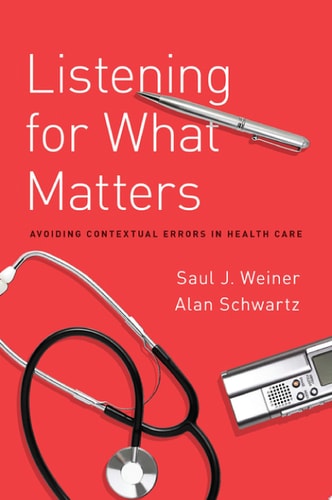
Listening For What Matters
0
0
As an Amazon Associate and affiliate partner, Menrva Books earns from qualifying purchases. Learn more
Author Description
Effective Health Care Requires Physicians Tailor Care To Patients' Individual Life Contexts, Including Their Financial Situation, Social Support, Competing Responsibilities, And Cognitive Abilities. Physicians, However, Are Poorly Prepared To Consider Patients' Lives When Planning Their Care. The Result Is Measurably Harmful To Individuals And Costly To Society. Listening For What Matters: Avoiding Contextual Errors In Health Care Covers Ten Years Of Empirical Research Based On Hundreds Of Recorded Doctor Visits By Patients And Undercover Actors Alike, Which Revealed A Widespread Disregard Of Patients' Individual Circumstances And Needs Resulting In Inappropriate Care. These Medical Errors Have Been Largely Undocumented And Unaddressed By The American Healthcare System. This Book Tells The Stories Of Patients Whose Care Was Compromised By Inattention To Individual Context, And Introduces Novel Methods For Assessing The Magnitude Of The Problem. It Describes How These Errors, Termed Contextual Errors, Can Be Minimized Through Changes In How Doctors Are Trained, How Medicine Is Practiced And Quality Measured, And In The Ways Patients Assert Their Needs During Visits. The Aim Of This Book Is To Open A Dialog Between Patients, Physicians, Policy Makers, And Medical Educators, About A Serious Quality Problem That Has Been Overlooked And Understudied.
Menrva's Summary
THE THESIS
This book investigates the prevalence and impact of contextual errors in medical practice, where physicians fail to account for a patient's individual life circumstances when developing treatment plans. Authors Alan Schwartz and Saul J. Weiner, both experts in medical education and health services research, utilize a decade of empirical data to demonstrate how ignoring factors like financial constraints and social support leads to suboptimal health outcomes. They argue that the current healthcare system lacks the necessary mechanisms to identify and mitigate these errors, proposing a structural shift in training and clinical interaction to improve quality of care.
THE SCOPE MAP
What You Will Find
- Analysis of hundreds of recorded doctor-patient interactions including undercover actor scenarios
- A formal definition and categorization of contextual errors in clinical settings
- Proposed methodologies for measuring the frequency and severity of these errors
- Strategies for medical educators and policymakers to integrate contextual awareness into clinical practice
Scope Limits
- The text focuses primarily on the American healthcare system and may not reflect global medical practices
- It does not provide a comprehensive clinical manual for treating specific diseases, focusing instead on the communication and diagnostic process
THE AUTHORITY PERSPECTIVE
Medical professionals and health policy experts frequently cite this work as a critical examination of the often-overlooked human element in clinical decision-making. Readers note that the prose is accessible to both practitioners and patients, providing a clear framework for addressing systemic failures in patient-centered care.
Page Count:
272
Publication Date:
2015-01-01
Publisher:
Oxford University Press
ISBN-10:
0190229004
ISBN-13:
9780190229009
Sociology of Medicine
Medical Education
Medicine
Public Health
Health Care
Community Tags
Similar Books