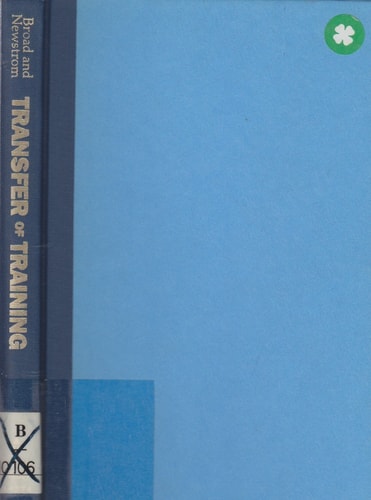
Transfer of Training: Action-packed Strategies to Ensure High Payoff from Training Investment
0
0
As an Amazon Associate and affiliate partner, Menrva Books earns from qualifying purchases. Learn more
Author Description
Transfer of Training n 1: the ability of persons to effectively apply to the job the knowledge and skills they gain in off-the-job education 2: learning in one situation that facilitates learning (and therefore performance) in subsequent similar situations 3: a development effort that induces significant new behavior on the job 4: the use of learning in the work situation 5: the maintenance of behavior; anything that maintains an acquired skill or knowledge to a performance standardExperts question the ultimate on-the-job effectiveness of employee development programs. By some estimates, corporations, nonprofit organizations, and governments spend about 50 billion each year for human resource development (HRD) for their employees; yet studies shot that only 10% of classroom learning is applies in the workplace. Today, with demands on corporate wallets coming from all sides, is any wonder that training budgets are often the first to be reduced—or even eliminated? Obviously the need to increase return on investment is of increasing concern to executives, making the transfer of training a crucial issue for today's trainers.In Transfer of Training, Mary Broad and John Newstron show why the full transfer of learned skills to the workplace is critical for the organization's growth and survival, and they present a systematic process for bringing managers and trainees into the transfer process so that the diverse workforce can benefit. They offer ways to manage the powerful role of ”manager of the transfer process,” and they provide the tools to get this important job done:
Menrva's Summary
THE THESIS
This book investigates the persistent gap between classroom-based employee training and actual on-the-job performance, seeking to maximize the return on organizational investment. Mary Broad and John Newstrom, experts in human resource development, address the critical issue of why only a small fraction of corporate training is successfully applied in the workplace. They propose a systematic, collaborative framework that integrates managers and trainees into the transfer process to ensure that educational initiatives yield measurable behavioral changes and performance improvements.
THE SCOPE MAP
What You Will Find
- A comprehensive definition of training transfer and its impact on organizational growth.
- Strategies for managing the role of the 'manager of the transfer process' to support employee skill application.
- A systematic process for aligning training objectives with workplace performance standards.
- Practical tools and methodologies for increasing the return on investment for human resource development programs.
THE AUTHORITY PERSPECTIVE
Experts and HR professionals frequently cite this work as a foundational text for understanding the mechanics of training implementation. Readers often note the practical utility of the provided tools for bridging the gap between theory and workplace application.
Page Count:
208
Publication Date:
1992-01-20
Publisher:
Basic Books
ISBN-10:
0201192748
ISBN-13:
9780201192742
Business
Training of
Management
Training
Human Resources
Employees
Professional Development
Community Tags
Similar Books