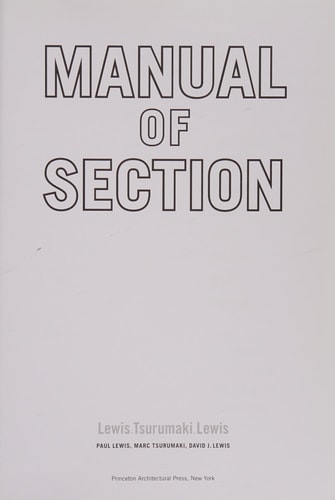
Manual of Section
0
0
As an Amazon Associate and affiliate partner, Menrva Books earns from qualifying purchases. Learn more
Author Description
Along with plan and elevation, section is one of the essential representational techniques of architectural design; among architects and educators, debates about a project's section are common and often intense. Until now, however, there has been no framework to describe or evaluate it. Manual of Section fills this void. Paul Lewis, Marc Tsurumaki, and David J. Lewis have developed seven categories of section, revealed in structures ranging from simple one-story buildings to complex structures featuring stacked forms, fantastical shapes, internal holes, inclines, sheared planes, nested forms, or combinations thereof. To illustrate these categories, the authors construct sixty-three intricately detailed cross-section perspective drawings of built projects—many of the most significant structures in international architecture from the last one hundred years—based on extensive archival research. Manual of Section also includes smart and accessible essays on the history and uses of section.
Menrva's Summary
THE THESIS
This book establishes a novel framework for understanding and evaluating architectural sections. Manual of Section addresses the lack of a systematic approach to this fundamental design technique by introducing seven distinct categories of section. The authors, David J. Lewis, Marc Tsurumaki, and Paul Lewis, utilize sixty-three detailed cross-section perspective drawings, derived from extensive archival research of significant international architectural projects from the past century, to illustrate these categories. The book also features insightful essays exploring the historical context and practical applications of architectural sections.
THE SCOPE MAP
- Seven categories of architectural section, illustrated with detailed cross-section perspective drawings.
- Sixty-three case studies of significant international architectural projects from the last 100 years.
- Extensive archival research underpinning the analysis of built projects.
- Essays on the history and uses of architectural section.
- Analysis of structures ranging from simple one-story buildings to complex, multi-form designs.
THE AUTHORITY PERSPECTIVE
The book is presented as a foundational text that fills a critical void in architectural discourse by providing a systematic framework for understanding sections. The authors' development of seven categories, supported by detailed drawings and historical research, aims to facilitate common and often intense debates among architects and educators. The inclusion of essays on the history and uses of section further contextualizes its importance in design practice and education. This work is positioned to become an indispensable resource for professionals and students alike.
Page Count:
208
Publication Date:
2016-08-23
Publisher:
Princeton Architectural Press
ISBN-10:
1616892552
ISBN-13:
9781616892555
Non-Fiction
Architecture
Design
Reference
Community Tags
Similar Books