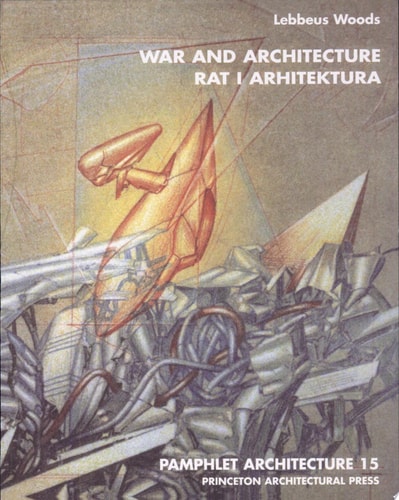
Pamphlet Architecture 15: War and Architecture
0
0
As an Amazon Associate and affiliate partner, Menrva Books earns from qualifying purchases. Learn more
Author Description
War and Architecture is a timely and moving response by architect Lebbeus Woods to the bombing of Sarajevo. With text in both English and Croatian, accompanied by the author's exquisitely drawn, hauntingly beautiful proposals, the book is both dedicated and addressed to the citizens of this ravaged city. Lebbeus Woods has long been fascinated by the intimate ties between architecture and violence. He identifies the two predominant patterns for rebuilding cities following catastrophic destruction: restoring the city exactly to its previous, "historical" state; or "erasing" the remains of the city to construct a new utopia. These, he argues, are twin forms of denial. Woods draws an analogy to the process of biological and emotional healing, presenting architectural forms that act as "injections," "scabs," "scars," and "new tissue," within the complex organism of a city. "Only by facing the insanity of willful destruction," he argues, "can reason begin to believe again in itself."
Menrva's Summary
THE THESIS
The book confronts the complex relationship between destruction and creation in the context of war-torn cities. Lebbeus Woods, an architect with a long-standing interest in the intersection of violence and the built environment, offers a profound response to the bombing of Sarajevo. He critiques the conventional approaches to post-destruction urban rebuilding—either restoration to a past state or the creation of a utopian new city—arguing that both represent forms of denial. Woods proposes architectural concepts, visualized through his drawings, that function as organic responses to trauma, akin to biological healing processes.
THE SCOPE MAP
- Analysis of architectural responses to urban destruction, specifically in the context of war.
- Critique of traditional rebuilding methods: restoration vs. utopian erasure.
- Metaphorical framework of architectural forms as 'injections,' 'scabs,' 'scars,' and 'new tissue' for city healing.
- Exploration of the psychological and philosophical implications of willful destruction and subsequent rebuilding.
- Presentation of author's original architectural proposals and drawings.
- Bilingual text in English and Croatian.
- Dedication and address to the citizens of Sarajevo.
THE AUTHORITY PERSPECTIVE
This work is recognized for its deeply personal and artistic engagement with the aftermath of conflict, offering a unique perspective from architect Lebbeus Woods. The book is noted for its poignant connection to the citizens of Sarajevo, providing solace and a framework for understanding trauma through architectural metaphor. Its exploration of rebuilding strategies challenges conventional notions of restoration and utopia, advocating for a more integrated approach to healing urban environments. The combination of Woods's evocative prose and his signature drawings creates a powerful and reflective statement on the resilience of cities and their inhabitants.
Page Count:
40
Publication Date:
1993-01-01
Publisher:
Princeton Architectural Press
ISBN-10:
1568980116
ISBN-13:
9781568980119
Non-Fiction
Art
Architecture
War Studies
urban planning
Community Tags
Similar Books