Planning with Complexity
0
0
As an Amazon Associate and affiliate partner, Menrva Books earns from qualifying purchases. Learn more
Author Description
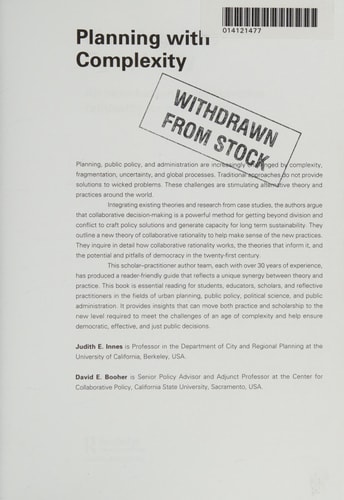
Planning, Public Policy, And Administration Are Increasingly Challenged By Complexity, Fragmentation, Uncertainty, And Global Processes. Traditional Approaches Do Not Provide Solutions To Wicked Problems. These Challenges Are Stimulating Alternative Theory And Practices Around The World. Integrating Existing Theories And Research From Case Studies, The Authors Argue That Collaborative Decision-making Is A Powerful Method For Getting Beyond Division And Conflict To Craft Policy Solutions And Generate Capacity For Long Term Sustainability. They Outline A New Theory Of Collaborative Rationality To Help Make Sense Of The New Practices. They Inquire In Detail How Collaborative Rationality Works, The Theories That Inform It, And The Potential And Pitfalls Of Democracy In The Twenty-first Century.--jacket. Thinking Differently For An Age Of Complexity -- How Can Theory Improve Practice? -- Stories From The Field -- The Praxis Of Collaboration -- Dialogue As A Community Of Inquiry -- Knowledge Into Action: The Role Of Dialogue -- Using Local Knowledge For Justice And Resilience -- Beyond Collaboration: Democratic Governance For A Resilient Society. Judith E. Innes And David E. Booher. Includes Bibliographical References (p. 216-228) And Index.
Menrva's Summary
THE THESIS
This book investigates how collaborative rationality can address the complex, fragmented, and uncertain challenges inherent in modern public policy and urban planning. Judith E. Innes and David E. Booher, both established scholars in planning theory, synthesize extensive case study research to argue that traditional top-down decision-making models are insufficient for contemporary "wicked problems." They propose a framework of collaborative rationality, which emphasizes dialogue and the integration of diverse knowledge sources to foster democratic governance and long-term sustainability.
THE SCOPE MAP
What You Will Find
- A theoretical framework for collaborative rationality in public administration.
- Analysis of how local knowledge contributes to social justice and community resilience.
- Case studies illustrating the practical application of collaborative decision-making.
- An exploration of the role of dialogue as a community of inquiry in policy development.
THE AUTHORITY PERSPECTIVE
Experts in the field of urban planning and public administration recognize this work as a significant contribution to the discourse on governance in complex systems. Readers frequently note the academic rigor of the text, describing it as a foundational resource for practitioners and students seeking to understand the shift toward collaborative policy-making models.
Page Count:
237
Publication Date:
2009-01-01
Publisher:
Routledge
ISBN-10:
0203864301
ISBN-13:
9780203864302
Art
Governance
Public Policy
urban planning
Sociology
Community Tags
Similar Books