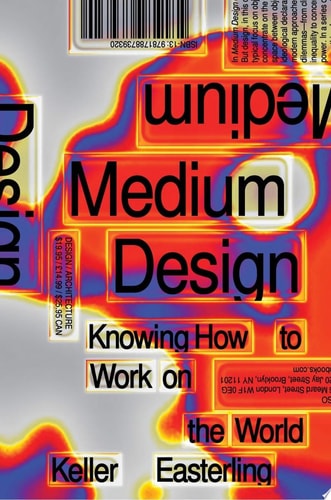
Medium Design
0
0
As an Amazon Associate and affiliate partner, Menrva Books earns from qualifying purchases. Learn more
Author Description
How to Design the World: Working Without Solutions In Medium Design everyone is a designer. But design, in this case, inverts the typical focus on object over its settings to concentrate on the medium—the matrix space between objects, events, and ideological declarations. It disrupts habitual modern approaches to the world’s intractable dilemmas—from climate cataclysm to inequality to concentrations of authoritarian power. In a series of case studies dealing with everything from automation and migration to explosive urban growth and atmospheric changes, Medium Design offers spatial tools for innovation and global decision-making to challenge the authority of more familiar legal or economic approaches. From this perspective, solutions are mistakes and ideologies are unreliable guides. Rather than the modern desire for the new, designers find more sophistication in relationships between emergent and incumbent technologies. Encouraging entanglement, medium design does not try to eliminate problems but rather to put them together in productive combinations. And in the process of reconceptualizing design, Easterling puzzles over bulletproof powers, Stanley Kubrick, ISIS recruits, literary characters, and iconic activists in the hope of outwitting political deadlocks and offering forms of activism for modulating power and temperament in organizations of all kinds.
Menrva's Summary
THE THESIS
The book investigates how to approach global dilemmas by focusing on the 'medium' or the space between elements, rather than seeking direct solutions. Keller Easterling, a recognized scholar in architecture and urbanism, utilizes a series of case studies to present a novel framework for design and decision-making. This approach challenges conventional legal and economic strategies by emphasizing the relationships between existing and emerging technologies and by encouraging productive combinations of complex issues. The book argues that solutions can be mistakes and that a deeper understanding of the medium can offer new forms of activism for modulating power.
THE SCOPE MAP
- Exploration of 'medium design' as an alternative to traditional problem-solving.
- Case studies on automation, migration, urban growth, and atmospheric changes.
- Analysis of spatial tools for innovation and global decision-making.
- Critique of familiar legal and economic approaches.
- Discussion of emergent vs. incumbent technologies.
- Consideration of bulletproof powers, political deadlocks, and activism.
- Examples drawn from diverse fields including art, politics, and organizations.
THE AUTHORITY PERSPECTIVE
The book offers a provocative re-conceptualization of design, shifting focus from objects to the interstitial spaces that shape them. Its approach is characterized by a willingness to engage with complex, seemingly intractable problems by seeking productive combinations rather than definitive solutions. The author's interdisciplinary method, drawing on examples from automation to political movements, suggests a dense and analytical text aimed at scholars and practitioners interested in innovative approaches to global challenges. The framing implies a critical examination of established systems and a proposal for new modes of intervention.
Page Count:
176
Publication Date:
2021-01-19
Publisher:
Random House Publishing Services
ISBN-10:
1788739345
ISBN-13:
9781788739344
Architecture
Non-Fiction
Social Science
Design
urban planning
Community Tags
Similar Books