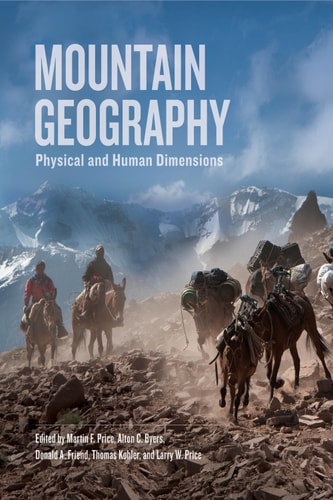
Mountain Geography
0
0
As an Amazon Associate and affiliate partner, Menrva Books earns from qualifying purchases. Learn more
Author Description
Mountains cover a quarter of the Earth’s land surface and a quarter of the global population lives in or adjacent to these areas. The global importance of mountains is recognized particularly because they provide critical resources, such as water, food and wood; contain high levels of biological and cultural diversity; and are often places for tourism and recreation and/or of sacred significance. This major revision of Larry Price’s book Mountains and Man (1981) is both timely and highly appropriate. The past three decades have been a period of remarkable progress in our understanding of mountains from an academic point of view. Of even greater importance is that society at large now realizes that mountains and the people who reside in them are not isolated from the mainstream of world affairs, but are vital if we are to achieve an environmentally sustainable future. Mountain Geography is a comprehensive resource that gives readers an in-depth understanding of the geographical processes occurring in the world’s mountains and the overall impact of these regions on culture and society as a whole. The volume begins with an introduction to how mountains are defined, followed by a comprehensive treatment of their physical geography: origins, climatology, snow and ice, landforms and geomorphic processes, soils, vegetation, and wildlife. The concluding chapters provide an introduction to the human geography of mountains: attitudes toward mountains, people living in mountain regions and their livelihoods and interactions within dynamic environments, the diverse types of mountain agriculture, and the challenges of sustainable mountain development.
Menrva's Summary
THE THESIS
This book investigates the multifaceted geographical, environmental, and societal significance of mountains worldwide. It addresses the critical role mountains play in providing resources, harboring biodiversity, and influencing global sustainability, building upon decades of academic progress and a growing societal awareness of their importance. The authors present a comprehensive resource detailing the geographical processes within mountain regions and their impact on culture and society.
THE SCOPE MAP
- Definitions and classification of mountains.
- Detailed treatment of physical geography: origins, climatology, snow and ice, landforms, geomorphic processes, soils, vegetation, and wildlife.
- Introduction to the human geography of mountains: attitudes, livelihoods, and interactions with dynamic environments.
- Exploration of diverse mountain agriculture practices.
- Analysis of the challenges and strategies for sustainable mountain development.
THE AUTHORITY PERSPECTIVE
This revised edition of a foundational text offers a comprehensive overview of mountain geography, integrating physical and human dimensions. The scope covers everything from the geological origins of mountains to the complexities of sustainable development in mountain communities. The book is structured to provide readers with an in-depth understanding of these vital regions and their global impact.
Page Count:
396
Publication Date:
2013-08-24
Publisher:
University of California Press
ISBN-10:
0520956974
ISBN-13:
9780520956971
Non-Fiction
Science
Development
Culture
Environment
Geography
Society
Community Tags
Similar Books