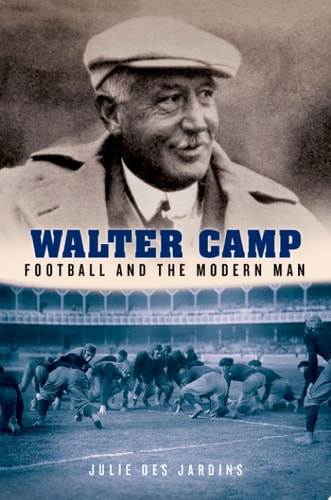
Walter Camp: Football and the Modern Man
0
0
As an Amazon Associate and affiliate partner, Menrva Books earns from qualifying purchases. Learn more
Author Description
Americans are obsessed with football, yet they know little about the man who shaped the game to make it uniquely technical, physical, and 'man-making' at once. Walter Camp, the "Father of American Football," was the foremost authority on American athletics and arguably the greatest amateur American athlete of his time. In Walter Camp: Football and the Modern Man, Julie Des Jardins chronicles the life of the clock company executive and self-made athlete who remade football and redefined the ideal man. As a student at Yale University, Camp was a varsity letterman who led the earliest efforts to codify the rules and organization of football-including the line of scrimmage and "downs"-to make it distinct from English rugby. He also invented the All-America Football Team and wrote some of the first football fiction, guides, and sports page coverage, making him the foremost popularizer of the game. Within a decade American football was an obsession on college campuses of the Northeast. By the turn of the century, it was a bona fide national pastime.Since the Civil War, college men of good breeding had not a physical skirmish to harden them. They had grown soft, Americans feared, both in body and attitude. Camp saw football as the antidote to the degeneration of these young men. When massive numbers of college football players enlisted to fight in World War I, Camp held them up as proof that football turned men effective and courageous. His influence over the game, however, was not always viewed as beneficial. Under his watch, dozens of college and high school players were killed or maimed on the gridiron. President Theodore Roosevelt urged him to reform football to prevent administrators from banning it, but Camp was ambivalent about removing the very physicality that made the game man-making in his eyes. The criticism targeted at him over the aggressiveness of football still haunts the game today.In this fast-paced biography, Julie Des Jardins shows how the "gentleman at
Menrva's Summary
THE THESIS
This biography investigates how Walter Camp transformed American football from a variation of rugby into a distinct, highly organized sport while simultaneously using the game to define a new ideal of American masculinity. Julie Des Jardins, a historian specializing in gender and sports, utilizes archival records and contemporary accounts to examine Camp's influence as a Yale athlete, rule-maker, and cultural architect. The book argues that Camp viewed the gridiron as a necessary corrective to the perceived physical and moral softening of American men following the Civil War.
THE SCOPE MAP
What You Will Find
- The evolution of football rules, including the introduction of the line of scrimmage and the down system.
- The intersection of early 20th-century athletics with concepts of national identity and manhood.
- The development of sports media and the invention of the All-America team.
Scope Limits
- The text does not provide a comprehensive technical history of football strategy beyond the early formative years.
- It does not focus on the professionalization of the sport in the late 20th century.
THE AUTHORITY PERSPECTIVE
Historians and sports scholars recognize this work as a significant contribution to the study of American athletic culture and gender history. Readers frequently note the balance between biographical detail and the broader social context of the Progressive Era.
Page Count:
387
Publication Date:
2015-01-01
Publisher:
Oxford University Press
ISBN-10:
0190231254
ISBN-13:
9780190231255
Biography
History
Football biography
Activities & Sports
Sports History
American History
Football
Community Tags
Similar Books