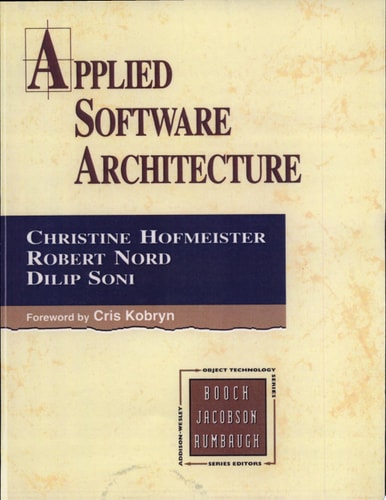
Applied Software Architecture
0
0
As an Amazon Associate and affiliate partner, Menrva Books earns from qualifying purchases. Learn more
Author Description
Designing a large software system is an extremely complicated undertaking that requires juggling differing perspectives and differing goals, and evaluating differing options. Applied Software Architecture is the best book yet that gives guidance as to how to sort out and organize the conflicting pressures and produce a successful design. -- Len Bass, author of Software Architecture in Practice.Quality software architecture design has always been important, but in today's fast-paced, rapidly changing, and complex development environment, it is essential. A solid, well-thought-out design helps to manage complexity, to resolve trade-offs among conflicting requirements, and, in general, to bring quality software to market in a more timely fashion.Applied Software Architecture provides practical guidelines and techniques for producing quality software designs. It gives an overview of software architecture basics and a detailed guide to architecture design tasks, focusing on four fundamental views of architecture--conceptual, module, execution, and code. Through four real-life case studies, this book reveals the insights and best practices of the most skilled software architects in designing software architecture. These case studies, written with the masters who created them, demonstrate how the book's concepts and techniques are embodied in state-of-the-art architecture design. You will learn how to:* create designs flexible enough to incorporate tomorrow's technology; * use architecture as the basis for meeting performance, modifiability, reliability, and safety requirements; * determine priorities among conflicting requirements and arrive at a successful solution; and * use software architecture to help integrate system components.Anyone involved in software architecture will find this book a valuable compendium of best practices and an insightful look at the critical role of architecture in software development.
Menrva's Summary
THE THESIS
This book investigates the methodology required to manage complex software system design by balancing conflicting requirements and technical constraints. The authors, Christine Hofmeister, Dilip Soni, and Robert Nord, leverage their extensive industry experience to provide a structured framework for architectural decision-making. They argue that a disciplined approach to design, centered on specific architectural views, is necessary to ensure software quality and long-term maintainability in rapidly evolving development environments.
THE SCOPE MAP
What You Will Find
- A comprehensive framework for four fundamental architectural views: conceptual, module, execution, and code.
- Practical techniques for resolving trade-offs between competing performance, reliability, and safety requirements.
- Four detailed, real-life case studies developed in collaboration with industry experts.
- Guidelines for creating flexible designs that accommodate future technological shifts.
THE AUTHORITY PERSPECTIVE
Experts and practitioners frequently cite this work as a foundational text for understanding the practical application of architectural principles in complex systems. Readers often note the clarity of the case studies, which effectively bridge the gap between theoretical design concepts and real-world implementation challenges.
Page Count:
432
Publication Date:
1999-01-01
Publisher:
Addison-Wesley Professional
ISBN-10:
0201325713
ISBN-13:
9780201325713
Software Architecture
System Design
Technology
Computer Science
Computer Architecture
Software Engineering
Community Tags
Similar Books