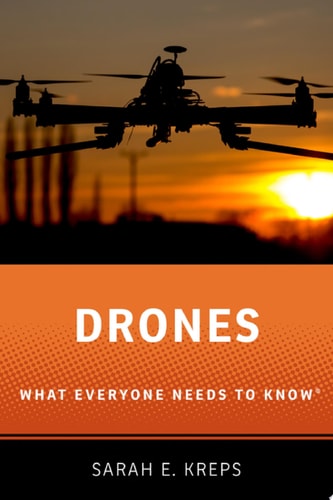
Drones: What Everyone Needs to Know
0
0
As an Amazon Associate and affiliate partner, Menrva Books earns from qualifying purchases. Learn more
Author Description
Drones quite possibly represent the most transformative military innovation since jet engines and atomic weaponry. No longer do humans have to engage in close military action or be in the same geographical vicinity as the target. Now, through satellite imaging and remote technology, countries such as the United States can destroy small targets halfway around the world with pinpoint accuracy.In the last several years, many of the military advancements have been rivaled by those in the commercial realm. Civilian industries have clamored to acquire drones for everything from monitoring crops to filming Hollywood movies to delivering packages. Not surprisingly, the use of drones has generated a lively debate, but no book thus far has engaged the range of themes surrounding drones. How do drones work? To what extent has the technology proliferated to other nations outside the US? How can they be used on the ground and in maritime environments? How are they being integrated into both military and civilian life?In Drones: What Everyone Needs to Know, the international relations scholar (and former air force officer) Sarah E. Kreps provides a concise synthesis of the topic. The book explains how they and the systems associated with them work, how they are being used today, and what will become of the technology in the future. What readers need now is a more practical guide to how this technology is reshaping both military and civilian life; this book is that guide. The drone revolution has already changed warfare, and will soon become a commonplace tool in a civilian context too. It is clear that drone technology is here to stay. Drones: What Everyone Needs to Know explains how the revolution happened, what its current contours are, and where we might be headed next.
Menrva's Summary
THE THESIS
How has the rapid proliferation of drone technology fundamentally altered the landscape of modern warfare and civilian industry? Sarah E. Kreps, an international relations scholar and former Air Force officer, examines the dual-use nature of unmanned aerial systems. By synthesizing technical capabilities with geopolitical analysis, she argues that drones represent a permanent shift in how states project power and how commercial sectors optimize operations.
THE SCOPE MAP
What You Will Find
- Technical overview of drone systems and satellite-linked remote operation
- Analysis of military deployment versus commercial integration
- Examination of global proliferation beyond United States borders
- Discussion of maritime and ground-based drone applications
Scope Limits
- Does not provide a manual for operating specific drone hardware
- Does not offer exhaustive legal case law regarding international drone strikes
THE AUTHORITY PERSPECTIVE
Experts recognize this work as a highly accessible primer for those seeking to understand the intersection of military innovation and civilian utility. Readers frequently note the clarity of the prose, which effectively distills complex geopolitical and technical concepts into a manageable format for non-specialists.
Page Count:
224
Publication Date:
2016-03-31
Publisher:
Oxford University Press
ISBN-10:
0190235357
ISBN-13:
9780190235352
International relations
Current Affairs
Technology
Military Science
Drone Aircraft
Aviation