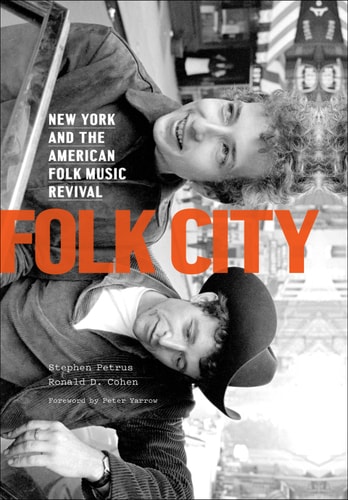
Folk City: New York and the American Folk Music Revival
0
0
As an Amazon Associate and affiliate partner, Menrva Books earns from qualifying purchases. Learn more
Author Description
From Washington Square Park and the Gaslight Café to WNYC Radio and Folkways Records, New York City's cultural, artistic, and commercial assets helped to shape a distinctively urban breeding ground for the folk music revival of the 1950s and 60s. Folk City explores New York's central role in fueling the nationwide craze for folk music in postwar America. It involves the efforts of record company producers and executives, club owners, concert promoters, festival organizers, musicologists, agents and managers, editors and writers - and, of course, musicians and audiences. In Folk City, authors Stephen Petrus and Ron Cohen capture the exuberance of the times and introduce readers to a host of characters who brought a new style to the biggest audience in the history of popular music. Among the savvy New York entrepreneurs committed to promoting folk music were Izzy Young of the Folklore Center, Mike Porco of Gerde's Folk City, and John Hammond of Columbia Records. While these and other businessmen developed commercial networks for musicians, the performance venues provided the artists space to test their mettle. The authors portray Village coffee houses not simply as lively venues but as incubators of a burgeoning counterculture, where artists from diverse backgrounds honed their performance techniques and challenged social conventions. Accessible and engaging, fresh and provocative, rich in anecdotes and primary sources, Folk City is lavishly illustrated with images collected for the accompanying major exhibition at the Museum of the City of New York in 2015.
Menrva's Summary
THE THESIS
This book investigates how New York City functioned as the primary urban engine for the American folk music revival during the 1950s and 1960s. Authors Ronald D. Cohen and Stephen Petrus, both established scholars in music and cultural history, utilize a wide array of primary sources and archival materials to document the intersection of commerce, artistry, and social activism. They argue that the revival was not merely a spontaneous cultural phenomenon but a structured movement supported by a complex network of producers, club owners, and promoters who transformed folk music into a significant commercial and social force.
THE SCOPE MAP
What You Will Find
- Detailed examination of the infrastructure supporting the folk revival, including record labels, radio stations, and performance venues.
- Profiles of key industry figures such as Izzy Young, Mike Porco, and John Hammond.
- Analysis of the role of Greenwich Village coffee houses as incubators for countercultural expression.
- Extensive visual documentation and historical photographs curated for the Museum of the City of New York exhibition.
Scope Limits
- The text focuses primarily on the New York City scene rather than providing a comprehensive history of folk music across the entire United States.
- It emphasizes the commercial and organizational aspects of the revival over deep musicological analysis of individual compositions.
THE AUTHORITY PERSPECTIVE
Experts and historians recognize this work as a definitive account of the institutional and social mechanisms that sustained the folk music movement in New York. Readers frequently note that the book provides a balanced perspective, successfully blending academic rigor with accessible prose that appeals to both music enthusiasts and students of urban history.
Page Count:
320
Publication Date:
2015-01-01
Publisher:
Oxford University Press
ISBN-10:
0190231041
ISBN-13:
9780190231040
Criticism history
Social History
Cultural History
Music History
Humanities
Music american
New York
American History
Folk Music
Community Tags
Similar Books