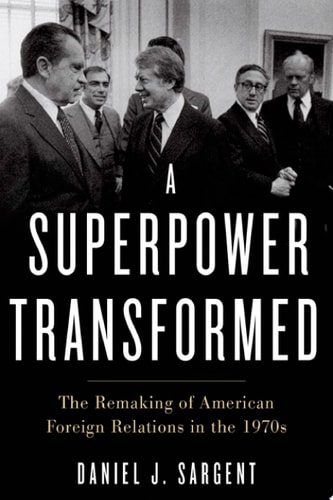
A Superpower Transformed
0
0
As an Amazon Associate and affiliate partner, Menrva Books earns from qualifying purchases. Learn more
Author Description
During The 1970s, American Foreign Policy Faced A Predicament Of Clashing Imperatives-us Decision Makers, Already Struggling To Maintain Stability And Devise Strategic Frameworks To Guide The Exercise Of American Power During The Cold War, Found Themselves Hampered By The Emergence Of Dilemmas That Would Come To A Head In The Post-cold War Era. Their Choices Proved To Be Of Enormous Consequence For The Development Of American Foreign Policy In The Final Decades Of The Twentieth Century And Beyond. In A Superpower Transformed, Daniel J. Sargent Chronicles How Policymakers Across Three Administrations Worked To Manage Complex International Changes In A Tumultuous Era. Drawing On Many Newly-released Archival Documents And Interviews With Key Figures, Including President Jimmy Carter And Dr. Zbigniew Brzezinski, Sargent Explores The Collision Of Geopolitics And Globalization That Defined The Decade. From The Nixon Administration's Efforts To Stabilize A Faltering Pax Americana; To Henry Kissinger's Attempts To Devise New Strategies To Manage Or Mitigate The Consequences Of Economic Globalization After The Oil Crisis Of 1973-74; To The Carter Administration's Embrace Of Human Rights Promotion As A Central Task For Foreign Policy, Sargent Explores The Challenges That Afflicted Us Policymakers In The 1970s, Offering New Insights Into The Complexities That Emerged As The New Forces Of Globalization And Human Rights Transformed The United States As A Superpower. A Sweeping Reinterpretation Of A Pivotal Era, A Superpower Transformed Is A Must-read For Anyone Interested In U.s. Foreign Relations, American Politics, Globalization, Economic Policy, Human Rights, And Contemporary American History.
Menrva's Summary
THE THESIS
How did the United States navigate the transition from Cold War stability to the complex, globalized challenges of the late twentieth century? Daniel J. Sargent, a historian of American foreign relations, examines the strategic shifts within the Nixon, Ford, and Carter administrations. By utilizing newly declassified archival materials and primary source interviews, Sargent argues that the 1970s served as a critical inflection point where traditional geopolitical concerns collided with the rising forces of economic globalization and human rights advocacy.
THE SCOPE MAP
What You Will Find
- Analysis of U.S. foreign policy shifts across the Nixon, Ford, and Carter administrations.
- Examination of the 1973-74 oil crisis and its impact on global economic strategy.
- Primary source evidence derived from archival documents and interviews with figures like Jimmy Carter and Zbigniew Brzezinski.
- Exploration of the integration of human rights promotion into the framework of American diplomatic objectives.
THE AUTHORITY PERSPECTIVE
Historians and political scientists recognize this work as a significant re-evaluation of the 1970s, noting its success in connecting domestic policy dilemmas to broader international trends. Scholars frequently cite the book for its rigorous use of archival evidence and its nuanced portrayal of the constraints faced by Cold War policymakers.
Page Count:
400
Publication Date:
2014-01-01
Publisher:
Oxford University Press
ISBN-10:
0199393613
ISBN-13:
9780199393619
History
Globalization
American History
Cold War
International relations
Community Tags
Similar Books