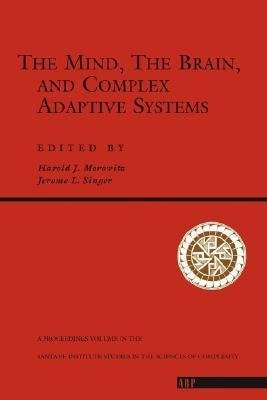
The Mind, The Brain, And Complex Adaptive Systems
0
0
As an Amazon Associate and affiliate partner, Menrva Books earns from qualifying purchases. Learn more
Author Description
This is a volume of thoughtful essays by a group of scientific leaders from physics, cognitive psychology, cognitive science, the philosophy of science, artificial intelligence, and brain psychology. It addresses fundamental issues such as, in the words of one of the contributors (Nobel Prize-winner Herbert A. Simon). ”How a mind resides in a brain.” The essays are set in the framework of the evolving scientific concept of complex adaptive systems, the basis for which is laid in an impressive essay by another Nobelist, physicist Murray Gell-Mann. The various chapters include studies of the neurobiology of mental representation, the brain architecture that bears on the organization of human memory, a connectionist approach to emotions and neuro-modulation, the possible neurobiological bases of consciousness, the new scientific understanding of human unconsciousness processes, and even the possibility of formulating a parallel distributed process computer simulation of daydreaming and nightdreaming. Scientists in the fields of brain biology, artificial intelligence, and psychology, as well as educators interested in the links of mind and brain, will find stimulating material for potential research and teaching in each chapter.
Menrva's Summary
THE THESIS
This volume investigates the fundamental scientific question of how a human mind resides within the physical architecture of the brain. Harold J. Morowitz compiles a series of essays from leading experts in physics, cognitive psychology, and artificial intelligence to explore this inquiry. The text utilizes the framework of complex adaptive systems to bridge the gap between neurobiological processes and higher-level mental functions. By integrating diverse disciplinary perspectives, the contributors attempt to synthesize a cohesive model for understanding consciousness and cognitive organization.
THE SCOPE MAP
What You Will Find
- Analysis of the neurobiology of mental representation and human memory organization.
- Connectionist approaches to modeling emotions and neuro-modulation.
- Theoretical frameworks for the neurobiological bases of consciousness and unconscious processes.
- Exploration of computer simulations for modeling cognitive phenomena like daydreaming.
- Foundational essays on the scientific concept of complex adaptive systems.
THE AUTHORITY PERSPECTIVE
Experts and researchers in the fields of brain biology and artificial intelligence identify this work as a significant interdisciplinary collection for those examining the intersection of mind and machine. Readers frequently note the academic density of the prose, which serves as a specialized resource for those engaged in advanced research or pedagogical development regarding cognitive systems.
Page Count:
256
Publication Date:
1995-01-20
Publisher:
Routledge
ISBN-10:
0201409887
ISBN-13:
9780201409888
Psychology
Science
Neuroscience
Community Tags
Similar Books