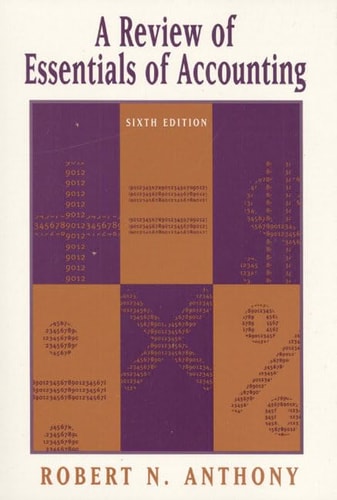
Essentials of Accounting
0
0
As an Amazon Associate and affiliate partner, Menrva Books earns from qualifying purchases. Learn more
Author Description
For courses in Introductory Accounting. Essentials of Accounting is a self-teaching, self-paced introduction to financial accounting for active users of business data - rather than preparers of accounting information (book keepers). It presents the ideas and terminology essential to an understanding of balance sheets, income statements, and statements of cash flows. Every frame requires students to solve a problem involving accounting information - e.g., selecting a correct word from two choices, providing an answer, making a journal entry, or preparing a complete balance sheet. Appropriate for undergraduate and graduate, executive, vocational or management training.*Self-teaching format - Consists of 11 Parts, each with an average of 75 'frames.' Each frame is a sentence or short paragraph that asks students to DO something relevant to the point being made*A detailed step-by-step approach that requires students to actively participate in the learning process and that guarantees mastery of basics*A serious focus on the use of information - Rather than on book keeping. Describes some of the complicated accounting practices*A gradual progression in level of rigor - Begins with a conceptual foundation; the mechanics of debits/credits, etc. come later in order not to detract from the underlying concepts*Helps students develop an understanding of essential ideas from basic concepts before moving on to more difficult material*Strong pedagogic support - Includes chapter objectives, 'key points to remember', post tests, and glossary*Provides students with convenient in-text study/review aids
Menrva's Summary
THE THESIS
This text investigates how individuals can master the fundamental concepts of financial accounting through a structured, self-paced learning methodology. Robert N. Anthony, a prominent authority in management accounting, utilizes a programmed instruction format to guide readers through the complexities of financial statements. The book prioritizes the interpretation and utility of business data over the mechanical tasks of bookkeeping, ensuring that users understand the logic behind balance sheets and cash flow statements.
THE SCOPE MAP
What You Will Find
- A modular curriculum divided into 11 parts containing approximately 75 frames each.
- A pedagogical framework requiring active problem-solving for every concept introduced.
- A conceptual progression that prioritizes underlying accounting principles before introducing technical mechanics like debits and credits.
- Integrated study aids including chapter objectives, key points, post-tests, and a comprehensive glossary.
THE AUTHORITY PERSPECTIVE
Experts and educators frequently cite this work as a foundational resource for non-accountants who require financial literacy for management roles. Readers often note the high level of engagement provided by the frame-based structure, which effectively reinforces learning through consistent practice.
Page Count:
179
Publication Date:
1996-01-01
Publisher:
Addison-Wesley
ISBN-10:
0201442787
ISBN-13:
9780201442786
Business
textbook
Finance
Education
Accounting
Community Tags
Similar Books