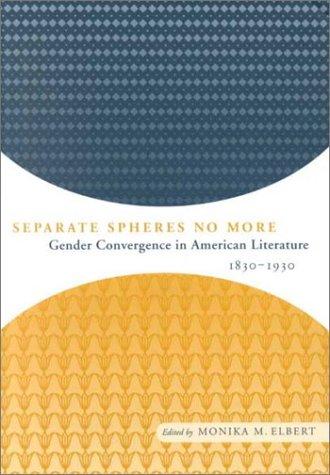
Separate Spheres No More
0
0
As an Amazon Associate and affiliate partner, Menrva Books earns from qualifying purchases. Learn more
Author Description
Although they wrote in the same historical milieu as their male counterparts, women writers of the 19th and early 20th centuries have generally been "ghettoized" by critics into a separate canonical sphere. These original essays argue in favor of reconciling male and female writers, both historically and in the context of classroom teaching. Each essay revises the binary notions that have been ascribed to males and females, such as public and private, rational and intuitive, political and domestic, violent and passive. Although they do not deny the existence of separate spheres, the contributors show the boundary between them to be much more blurred than has been assumed until now.
Menrva's Summary
THE THESIS
This collection challenges the critical segregation of 19th and early 20th-century women writers into a separate canonical sphere. The essays argue for a reintegration of male and female writers, both historically and in pedagogical contexts, by revising binary notions of gendered spheres like public/private, rational/intuitive, and political/domestic. While acknowledging the historical existence of separate spheres, the contributors demonstrate that the boundaries between them were far more fluid than previously understood.
THE SCOPE MAP
- Reconciliation of male and female writers within literary criticism.
- Analysis of 19th and early 20th-century literary contexts.
- Revision of binary gendered notions (public/private, rational/intuitive, political/domestic, violent/passive).
- Demonstration of blurred boundaries between historical 'separate spheres'.
- Implications for classroom teaching and literary canon formation.
THE AUTHORITY PERSPECTIVE
This collection is regarded as a significant contribution to feminist literary criticism, advocating for a more integrated understanding of the literary landscape of the 19th and early 20th centuries. The essays collectively dismantle traditional critical approaches that have historically isolated women writers. By examining the interplay between male and female authors and their shared historical milieu, the book offers a nuanced perspective on gendered literary spheres. Its arguments are particularly relevant for educators seeking to broaden and de-gender literary curricula.
Page Count:
307
Publication Date:
2000-01-01
ISBN-10:
0817310363
History
Non-Fiction
Literary Criticism
19th Century
Feminist Theory
20th Century
Community Tags
Similar Books