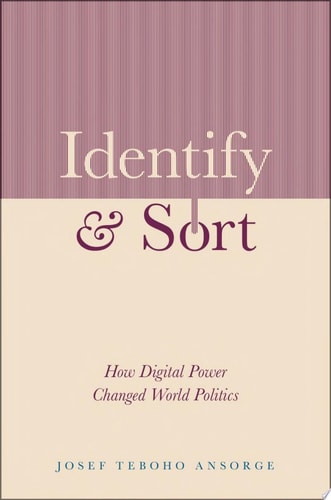
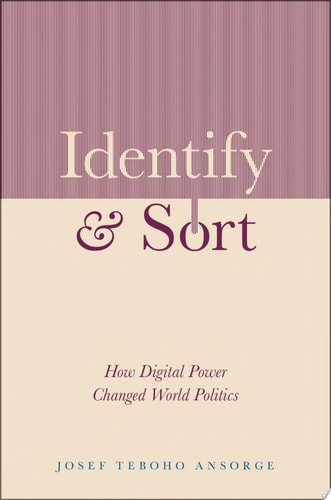
Identify and Sort
0
0
As an Amazon Associate and affiliate partner, Menrva Books earns from qualifying purchases. Learn more
Author Description
The Advent Of Information Technology Ushered In New Forms Of Political Power. Machines Play Crucial Roles In How States See, Understand, And Act, And Scrutiny Of These Processes Lies At The Heart Of Identify And Sort. It Frames Debates About It In World Politics, Explaining How Industrial Sorting Systems Employed By Political Actors Are Renegotiating The Social Contract Between Individuals And The State. Ansorge Takes The Reader On A Global Expedition That Tracks The Historical Antecedents Of Digital Power, From Aztec And Inca Rituals, To Medieval Filing Systems, To A Grandiose 1930s Design For A German Registry, To The Databases Used In Us Presidential Campaigns And How It Is Deployed In War And Post-conflict Reconstruction. Databases Are Also Deployed Virtually To Record And Act Upon People Who Have No Publicly Visible Identification Or Group Consciousness; Modern Wars And Election Campaigns Are Fought On This Individualised Terrain. The Uneven Distribution Of These Technical Capacities Engenders Inequality Of Access, While Rights Discourses And Legal Frameworks Forged In An Era Of Mass Group Discrimination, Subjugation, And Public Resistance Lag Behind These Micro-targeting Practices. Rich In Examples And Ideas, Identify And Sort Develops An Analytical Model And Vocabulary To Explain The Functions And Limits Of Digital Power In World Politics.
Menrva's Summary
THE THESIS
How do industrial sorting systems and information technology redefine the social contract between the state and the individual in the modern era? Josef Teboho Ansorge, a scholar of international relations and technology, examines the historical evolution of classification systems to argue that digital power has fundamentally altered political governance. By tracing the lineage of data management from ancient civilizations to contemporary micro-targeting, the author establishes a framework for understanding how states utilize databases to monitor, categorize, and influence populations. The text posits that existing legal and rights-based frameworks are currently insufficient to address the unique challenges posed by these individualized technical capacities.
THE SCOPE MAP
What You Will Find
- Historical analysis of classification systems ranging from Aztec and Inca rituals to medieval record-keeping.
- Case studies on the application of digital databases in US presidential campaigns and modern warfare.
- An analytical model for evaluating the functions and limits of digital power in global politics.
Scope Limits
- The text does not provide a technical manual for database architecture or software engineering.
- It does not offer a comprehensive legal guide for individual data privacy compliance.
THE AUTHORITY PERSPECTIVE
Scholars and political analysts frequently cite this work for its interdisciplinary approach to the intersection of history and digital governance. Readers often note the academic density of the prose, which serves as a foundational text for those studying the sociopolitical implications of modern surveillance and data-driven statecraft.
Page Count:
288
Publication Date:
2015-01-01
Publisher:
Oxford University Press
ISBN-10:
0190245565
ISBN-13:
9780190245566
History
Sociology
Technology
International relations
Community Tags
Other Editions(2)
Similar Books