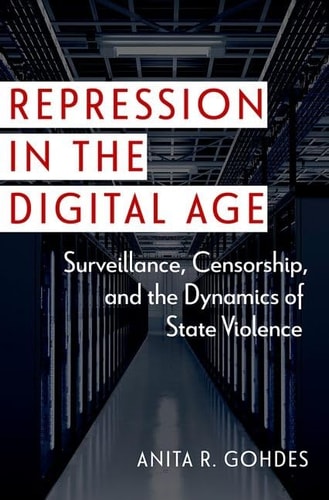
Repression in the Digital Age: Surveillance, Censorship, and the Dynamics of State Violence
0
0
As an Amazon Associate and affiliate partner, Menrva Books earns from qualifying purchases. Learn more
Author Description
Global adoption of the Internet has exploded, yet we are only beginning to understand the Internet's profound political consequences. Authoritarian states are digitally catching up with their democratic counterparts, and both are showing a growing interest in the use of cyber controls--online censorship and surveillance technologies--that allow governments to exercise control over the Internet. Under what conditions does a digitally connected society actually help states target their enemies? Why do repressive governments sometimes shut down the Internet when faced with uprisings? And how have cyber controls become a dependable tool in the weapons arsenal that states use in civil conflict?In Repression in the Digital Age, Anita R. Gohdes addresses these questions, and provides an original and in-depth look into the relationship between digital technologies and state violence. Drawing on large-scale analyses of fine-grained data on the Syrian conflict, qualitative case evidence from Iran, and the first global comparative analysis on Internet outages and state repression, Gohdes makes the case that digital infrastructure supports security forces in their use of violent state repression. More specifically, she argues that mass access to the Internet presents governments who fear for their political survival with a set of response options. When faced with a political threat, they can either temporarily restrict or block online public access or they can expand mass access to online information and monitor it to their own advantage. Surveillance allows security forces to target opponents of the state more selectively, while extreme forms of censorship or shutdowns of the Internet occur in conjunction with larger and more indiscriminate repression. As digital communication has become a bedrock of modern opposition and protest movements, Repression in the Digital Age breaks new ground in examining state repression in the information age.
Menrva's Summary
THE THESIS
This book investigates how digital infrastructure and cyber controls, such as surveillance and censorship, function as strategic tools for state violence and political repression in the modern era. Anita R. Gohdes, a scholar specializing in the intersection of technology and conflict, utilizes a combination of large-scale quantitative data and qualitative case studies to examine how governments leverage internet connectivity to maintain power. The central argument posits that digital access provides states with a dual-option framework: they can either monitor online activity to selectively target dissidents or implement widespread shutdowns to suppress large-scale opposition movements.
THE SCOPE MAP
What You Will Find
- Quantitative analysis of internet outages and state repression on a global scale.
- Detailed examination of the Syrian conflict as a primary data set for digital state violence.
- Qualitative case evidence regarding government control strategies in Iran.
- A theoretical framework explaining the correlation between digital infrastructure and the efficacy of security forces.
THE AUTHORITY PERSPECTIVE
Experts recognize this work as a significant contribution to the study of digital authoritarianism and state security. Readers frequently note the rigorous empirical approach Gohdes takes in connecting abstract digital policy to concrete physical violence.
Page Count:
200
Publication Date:
2023-01-01
Publisher:
Oxford University Press
ISBN-10:
0197743579
ISBN-13:
9780197743577
Politics
Technology
Elections & Political Process
Sociology
Specific Topics
International relations
Human rights
Community Tags
Similar Books