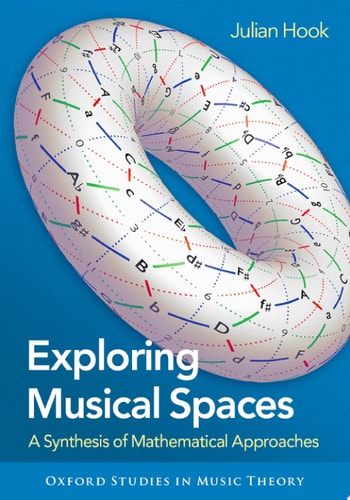
Exploring Musical Spaces: A Synthesis of Mathematical Approaches
0
0
As an Amazon Associate and affiliate partner, Menrva Books earns from qualifying purchases. Learn more
Author Description
Exploring Musical Spaces is a comprehensive synthesis of mathematical techniques in music theory, written with the aim of making these techniques accessible to music scholars without extensive prior training in mathematics. The book adopts a visual orientation, introducing from the outset a number of simple geometric models―the first examples of the musical spaces of the book's title―depicting relationships among musical entities of various kinds such as notes, chords, scales, or rhythmic values. These spaces take many forms and become a unifying thread in initiating readers into several areas of active recent scholarship, including transformation theory, neo-Riemannian theory, geometric music theory, diatonic theory, and scale theory. Concepts and techniques from mathematical set theory, graph theory, group theory, geometry, and topology are introduced as needed to address musical questions. Musical examples ranging from Bach to the late twentieth century keep the underlying musical motivations close at hand. The book includes hundreds of figures to aid in visualizing the structure of the spaces, as well as exercises offering readers hands-on practice with a diverse assortment of concepts and techniques.
Menrva's Summary
THE THESIS
How can mathematical frameworks be applied to music theory to provide a unified, visual understanding of musical relationships? Julian Hook, a scholar in music theory and mathematics, synthesizes complex analytical techniques into an accessible format for musicologists. The book argues that geometric models and algebraic structures offer a robust methodology for mapping the relationships between notes, chords, and rhythmic values across diverse musical repertoires.
THE SCOPE MAP
What You Will Find
- Geometric models of musical spaces including notes, chords, scales, and rhythms
- Applications of transformation theory, neo-Riemannian theory, and diatonic theory
- Mathematical foundations in set theory, graph theory, group theory, and topology
- Musical examples spanning from J.S. Bach to twentieth-century compositions
- Pedagogical exercises for practical application of theoretical concepts
Scope Limits
- The text assumes a basic interest in music theory and does not serve as a general introduction to music history
- It does not cover advanced computational musicology or algorithmic composition in depth
THE AUTHORITY PERSPECTIVE
Experts recognize this work as a significant contribution to the field of geometric music theory, noting its success in bridging the gap between abstract mathematics and practical musical analysis. Readers frequently highlight the clarity of the visual figures and the pedagogical effectiveness of the exercises for students and scholars alike.
Page Count:
680
Publication Date:
2022-11-25
Publisher:
Oxford University Press
ISBN-10:
0190246014
ISBN-13:
9780190246013
Mathematics
Musicology
Academic
Music Analysis
Geometry
Music theory
Community Tags
Similar Books