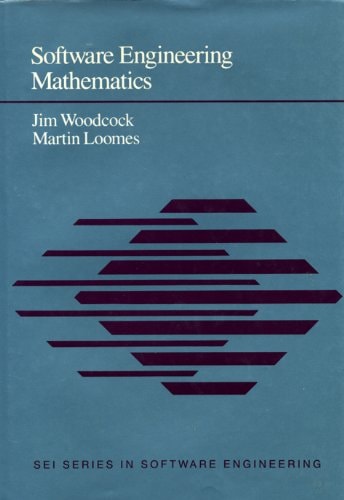
Software Engineering Mathematics
0
0
As an Amazon Associate and affiliate partner, Menrva Books earns from qualifying purchases. Learn more
Author Description
This book makes the mathematical basis of formal methods accessible both to the student and to the professional. It is motivated in the later chapters by examples and exercises. Throughout, the premise is that mathematics is as essential to design and construction in software engineering as it is to other engineering disciplines. The exercises range from simple drills, intended to provide familiarity with concepts and notation, to advanced material. The first four chapters of the book are devoted to foundations, with an introduction to formal systems, then the propositional and predicate calculi, concluding with a chapter on theories in general. The second part of the book builds upon the foundations by covering in detail the theory of sets, relations, functions, and sequences. The mathematical data types then presented are powerful enough to describe many aspects of software systems, and small case studies are included as examples of their use in the modelling of a configuration manager, a storage allocator, and a simple backing store interface. The concrete syntax of the Z notation has been adopted. The third part of the book presents two detailed case studies in the use of mathematics in software engineering. The first is the specification of the behaviour of a telephone exchange, and the second illustrates the importance of the development of a mathematical theory in gaining an understanding of a system. Both case studies stress the roles of modelling and of proof in the construction of specifications. The final part describes the algebraic approach to specification and then summarizes and compares the various formal techniques.
Menrva's Summary
THE THESIS
This book investigates the necessity of establishing a rigorous mathematical foundation for software engineering, arguing that formal methods are as critical to software design as they are to traditional engineering fields. Authors Jim Woodcock and Martin Loomes, both established experts in formal methods, provide a structured framework that bridges the gap between abstract mathematical theory and practical software construction. By utilizing the Z notation, the authors demonstrate how formal systems, propositional calculus, and set theory can be applied to model and verify complex software systems.
THE SCOPE MAP
What You Will Find
- Foundational coverage of formal systems, propositional calculus, and predicate calculus.
- Detailed theory of sets, relations, functions, and sequences for software modeling.
- Practical case studies including a configuration manager, a storage allocator, and a telephone exchange.
- An overview of the algebraic approach to specification and a comparative analysis of formal techniques.
THE AUTHORITY PERSPECTIVE
Experts and educators frequently cite this text as a foundational resource for understanding the application of formal methods in software development. Readers often note the academic density of the prose, which requires a solid grasp of discrete mathematics to fully appreciate the technical rigor presented.
Page Count:
271
Publication Date:
1989-01-01
Publisher:
Addison-Wesley
ISBN-10:
0201504243
ISBN-13:
9780201504248
Mathematics
Software Engineering
textbook
Computer Science
Formal Methods
Community Tags
Similar Books